
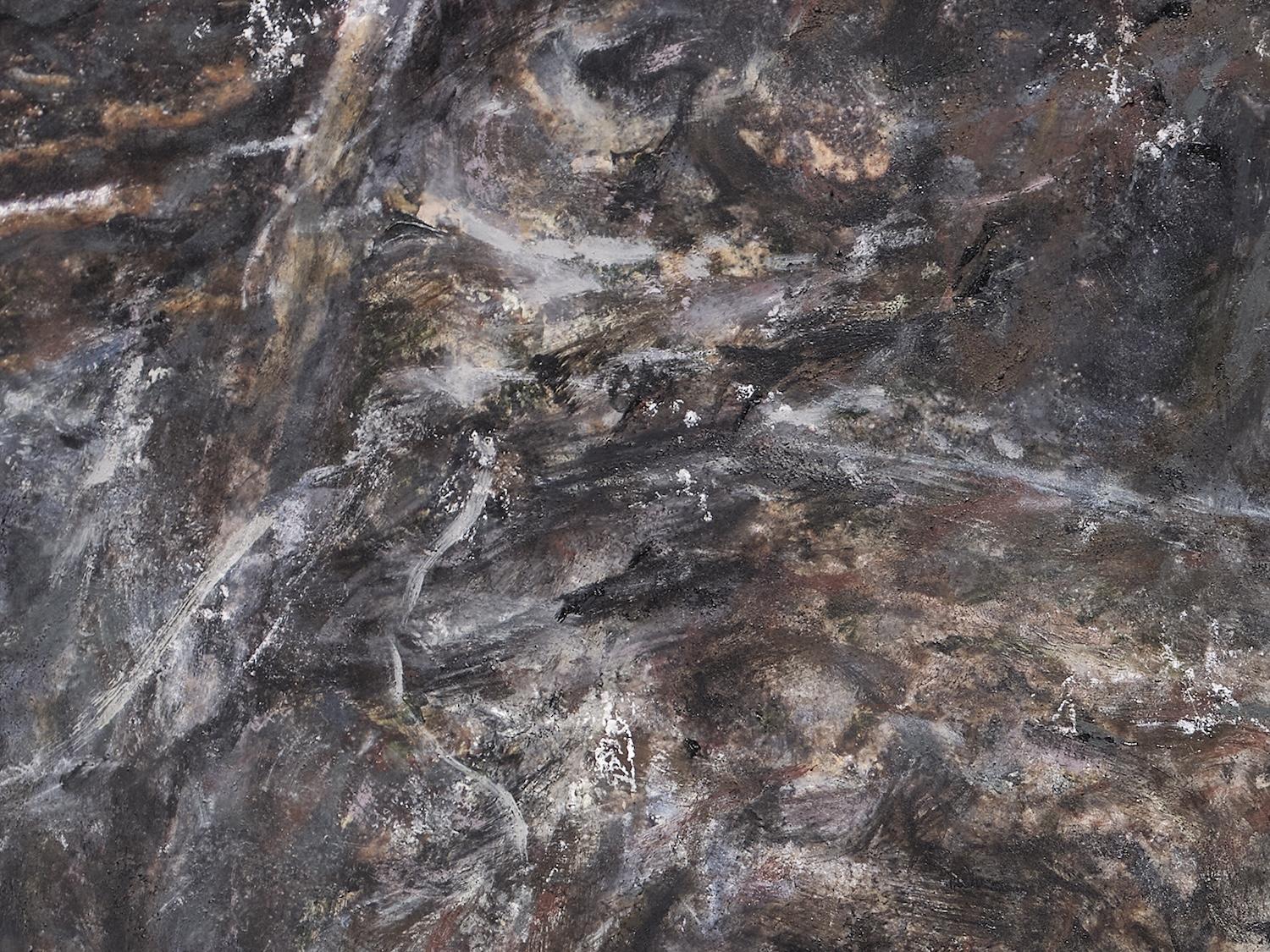
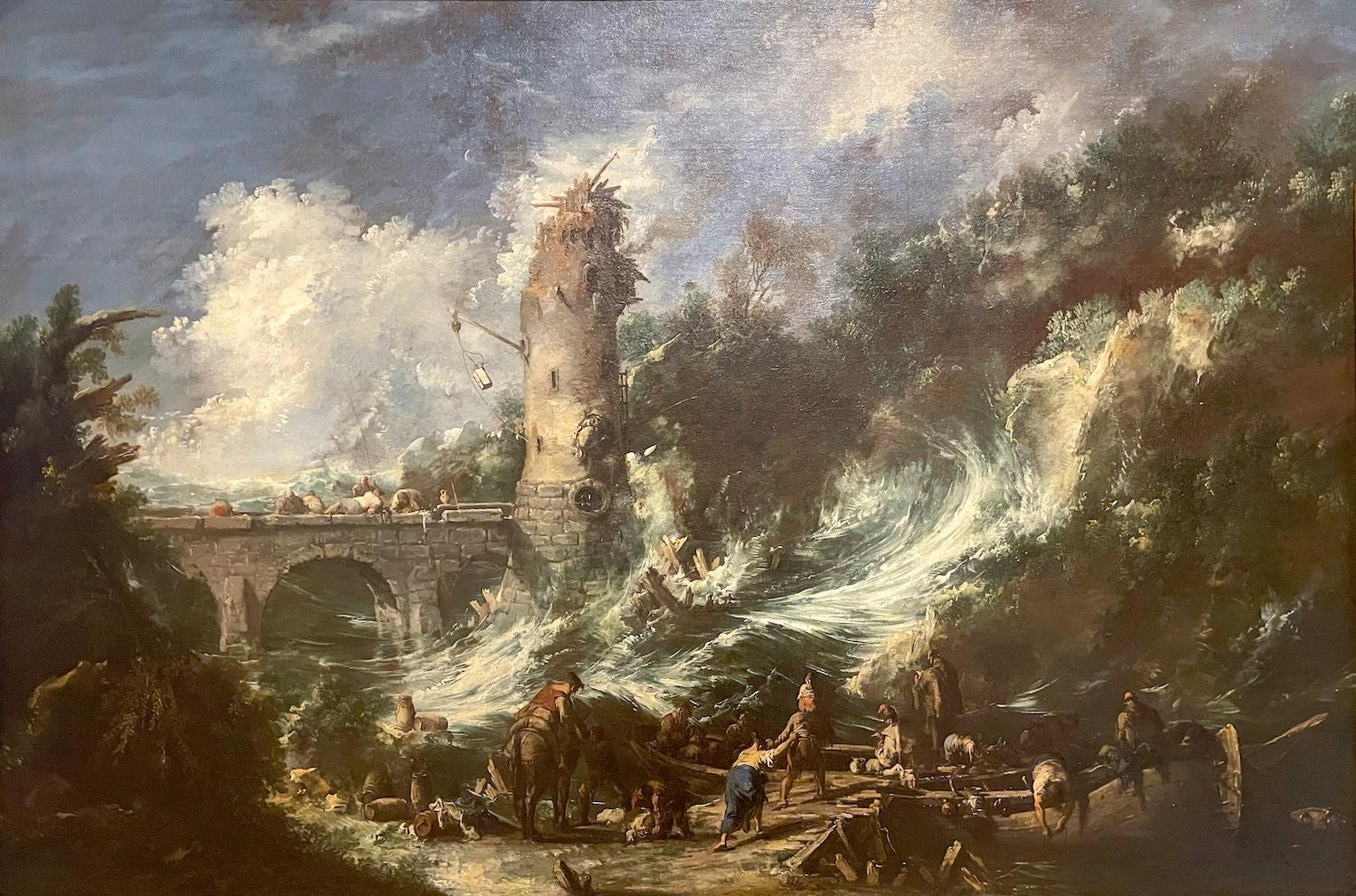
Hidden away in the enlarged photographic details of historical artists, Hyde has found places in which to paint. In the late 1980s, he emerged as an abstractionist attentive to the material nature of form and the architectural context of painting. “A sea change in my art came about around 2003,” Hyde says. “I had an intuition that photography was inescapable. I was taking pictures to document my paintings, and then it seemed that photography had become so powerful that a painting might not exist unless it had been photographed.”
Following the Magnasco viewing at the Met, we had lunch and hopped a cab down the East River Drive to Hyde’s studio on the Gowanus Canal. There, we discussed his large vinyl-billboard “Magnascos.” He explains, “I make these by applying layers of various grits, powders, and glass beads in dispersion with acrylic mediums as well as using house paint and metallic paints.” Referring to Hyde’s show in Glasgow last year, the YouTube art critics “The Painting Nerds” said that Hyde’s “Midas (Magnasco) of 2018 is an investing in, and investigation of, painting. How and where, he asks, does it take place? Of what is it constituted? For Hyde, parts and wholes, fragments and restorations are part of the poetry and tradition of painting. How these elements are expressed and performed, Hyde believes, goes a long distance to defining a painting, its program and its marker’s attitude.”
Discussing his work with me, Hyde says, “I often have many different things going on in my painting, and work on them simultaneously.” He points to recent paintings based on the works of the 16th-century Flemish landscape painter Paul Bril, which unfortunately we could not view because there are none on display in New York museums. Like Magnasco, Bril is not widely appreciated. Hyde’s Bril paintings are smaller than the Magnascos. “I wanted to find a way to condense what I was doing with the billboard-size Magnascos,” says the artist. In his Bril series, Hyde channels the Flemish artist’s “pantheistic” landscapes built of such matter as suggests pieces of nature: animals, branches of trees, rocks, waterfalls, even suggestions of tiny faces, all embedded as painting ideas. In several of Hyde’s paintings, Bril’s images of little birds, leaves, even a rabbit, can be seen through Hyde’s overlaid web of abstract painting.
In the rich mix of art history and time, we can detect depth and power in Hyde’s painting over or reworking of landscapes—in streaks and pockets of white and of traces of red, as in Corot’s skies and forests. We do see the trees for the forest. We also detect the pastels of de Kooning canvases by the bay and the fierce browns and dark greens of Pollock’s wildness. If we look East, so to speak, we can see some gold woven into the hills and the stacked inclines of Chinese paintings—nothing specific but rather as the subtle, underlying armatures of Hyde’s paintings.
Over his almost five-decade career, Hyde’s material repertoire has included fresco on Styrofoam supports, paintings suspended in glass boxes, wall hangings of brightly colored beach-chair webbing, and recently a digital animation of augmented reality in collaboration with Nathan Hauenstein, an artist who engages with painting, technology, and music. Set in a public street in industrial Brooklyn, the work was viewable by clicking through a QR code in a public letterbox on the side of a building. Through a smartphone, the 40-foot-in-diameter multicolored Halo could be discovered slowly rotating overhead. This might well have been Hyde’s way to incorporate viewers into the atmosphere of art history’s time and space.
If Hyde eschews narrative in painting, he instead stakes his claim in the world of painting—in his own particular universe of substance and illusion.
*This article originally appeared in Art & Object Magazine's Fall 2025 issue.