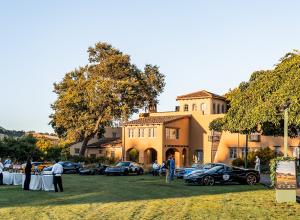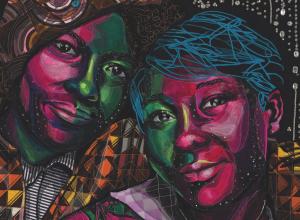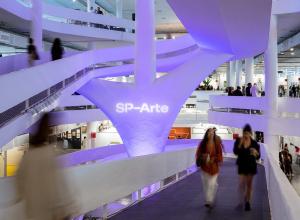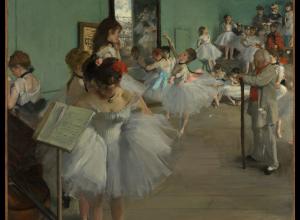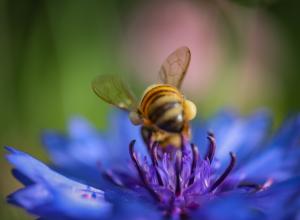
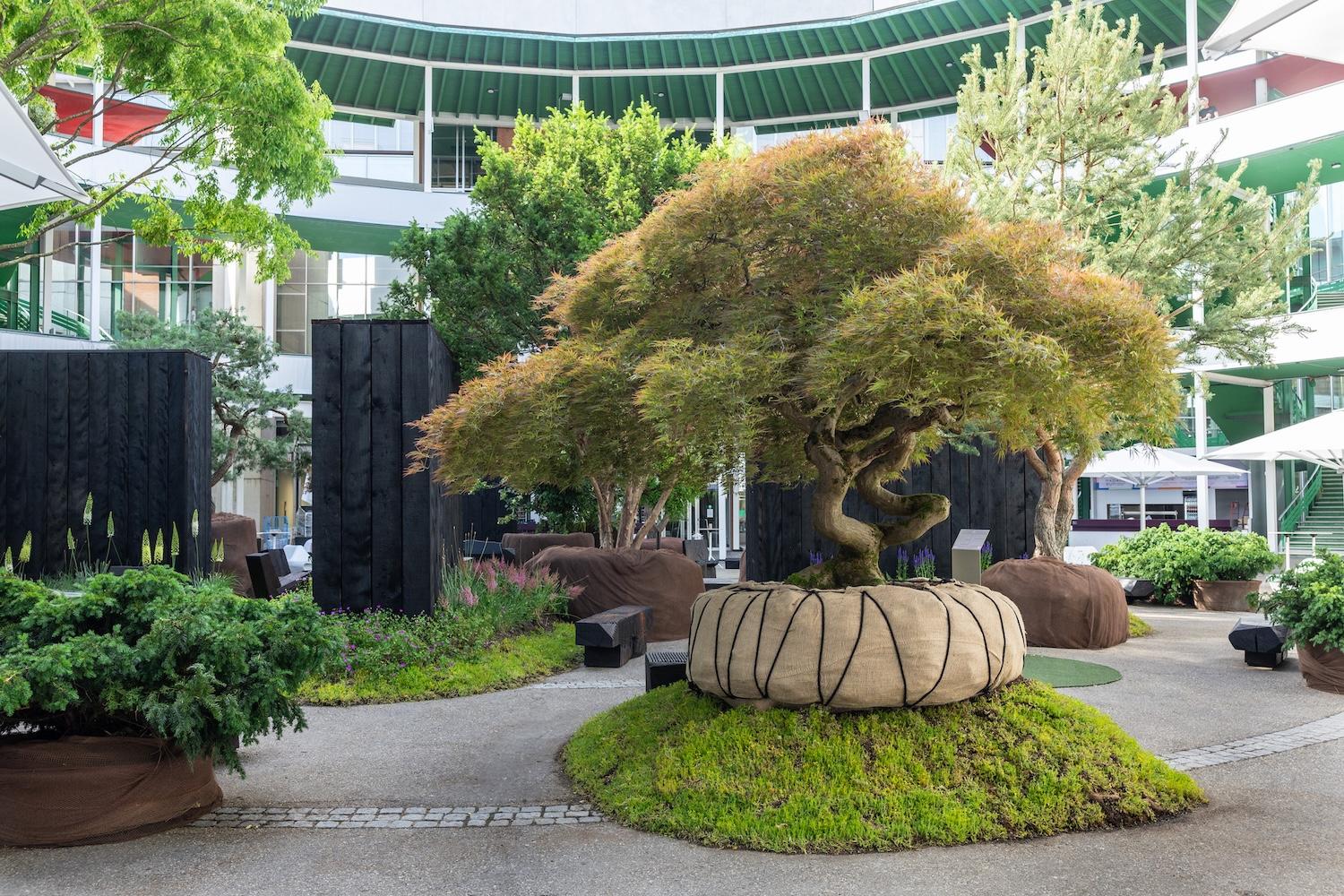
Nature Installation, The Living Fragment: Enea Tree Museum at the Rundhof of Art Basel 2026.
Hosting some 90,000 visitors from June 15-21, the 2026 edition of Art Basel showcased 290 galleries from 43 countries and territories, featuring a diverse range of works, including Modern and postwar masterpieces, historical rediscoveries, contemporary and emerging positions, large-scale installations, and cross-media practices.
Galleries reported strong sales across multiple sectors and price ranges, reaffirming Basel as the top international art fair. It drew a global audience from 103 countries, including leading collectors and arts professionals, as well as over 270 museum and foundation representatives, underscoring Basel’s role as a key meeting spot for the international art community.
At the center of the fair, award-winning landscape architect Enzo Enea created a delightfully immersive nature installation in the Messe Basel’s circular courtyard, serving as an atmospheric garden that combined trees, native and resilient plants, and sustainable design to highlight themes such as climate change, biodiversity, and resilience.
Scroll through to see a curated selection of our favorite contemporary artworks at the fair.
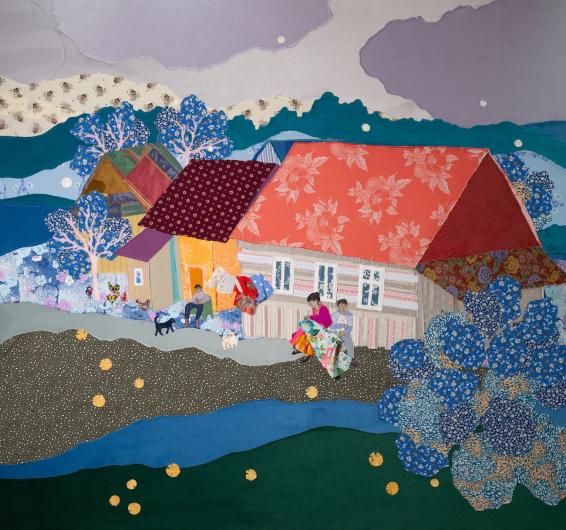
A celebrated Polish-Romani visual artist, educator, and activist, Małgorzata Mirga-Tas is best known for creating large, colorful textile collages and patchworks, though she also makes cardboard and wax sculptures, screen installations, and animated films. A member of the Bergitka Roma tribe, she achieved major international recognition as the first-ever Roma artist to represent any country at the Venice Biennale; she represented Poland in the National Pavilion at the 59th exhibition in 2022.
At the gallery’s booth, Mirga-Tas exhibited Sewing in front of the House, a recent textile collage documenting everyday life in her community in the mountainous village of Czarna Góra, where clothes blow in the wind on a clothesline, and neighbors gather outside their homes.
Image: Małgorzata Mirga-Tas, Sewing in front of the House, 2026.
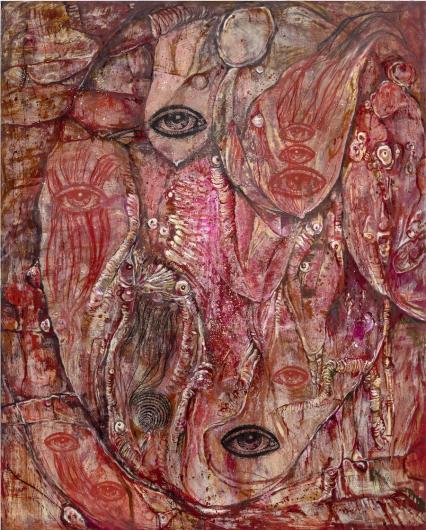
Jang Pa, a leading contemporary South Korean artist, is best known for her daring feminist artwork that challenges patriarchal visual norms and portrays the female body as an independent, multifaceted subject. Investigating historically male-centric visual vocabularies, she gathers and transforms misogynistic images from art history and popular culture into provocative, subversive critiques.
In paintings like My Soul Is Pink #1, one of three works in her Kabinett sector solo presentation, she intentionally rejects conventional ideas of feminine beauty. Instead, she investigates the female grotesque, employing bright, fluorescent hues and flowing, warped textures to portray the female form in active, fluid, and transformative states, while attaching human hair to her internal organ-like forms, which are masked with multiple eyes that return the spectator’s gaze.
Image: Jang Pa, My Soul Is Pink #1, 2026.
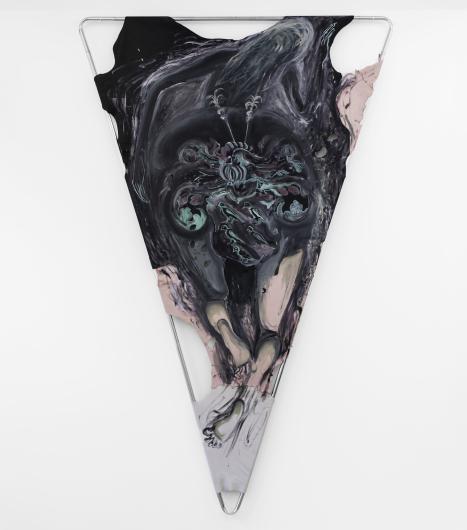
Raphaela Vogel is a well-known contemporary German artist celebrated for her immersive, large-scale multimedia installations. Her distinctive approach combines sculpture, experimental video, audio collages, and performance, often exploring the tension between human and animal biology and technological systems. Her expansive installations prominently feature transformed readymades, industrial objects, and animal motifs. She uses raw materials such as animal hides (goat, deer, elk, and cow leather) as unconventional canvases for her paintings.
Her 2026 painting, Caterina Sforza, is part of a series of triangular painted panels on view in her current solo show at the gallery’s Zurich location. The panels reference the female pubis, a traditional surface of projection in Western art, and complex triadic conceptual frameworks—suggesting that the defining dynamics of our lives, politics, and logic are not merely bipolar or binary.
Image: Raphaela Vogel, Caterina Sforza, 2026.
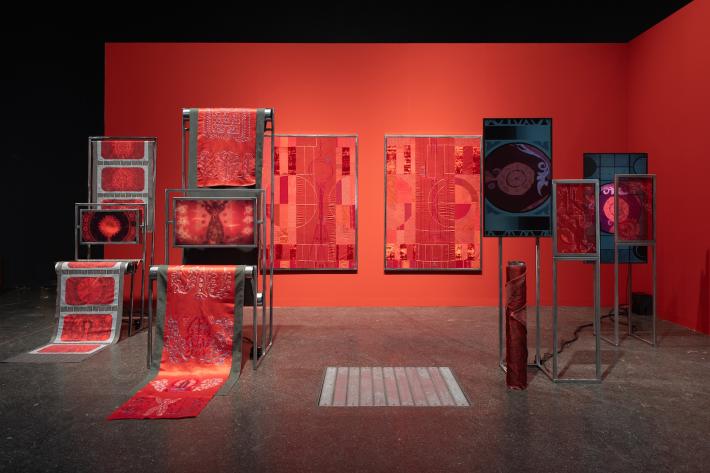
A London-based, Uzbek multidisciplinary artist who creates immersive physical and digital installations, textiles, experimental costumes, sculptures, and performances, Aziza Kadyri gained major international recognition after representing Uzbekistan at the 60th Venice Biennale in 2024. Blending traditional embroidery with contemporary technologies such as artificial intelligence and interactive displays, she employs suzani patterns—an ancient Central Asian textile art form—to examine how cultural traditions evolve and are transmitted across generations.
At Zero 10, the fair's digital art and emerging technology section, Kadyri exhibited an interactive multimedia piece titled A Borrowed Hand to explore the limits of collective memory, cultural preservation, and technological bias. The deliberate use of errors, distortions, and misinterpretations in the software aimed to reveal Western-centric biases and cultural gaps within modern digital systems. Her highly praised presentation coincided with her winning the global Emerging Artist category at the 2026 Art Basel Awards.
Image: Aziza Kadyri, A Borrowed Hand, 2026, presented by eastcontemporary. Art Basel Zero 10.
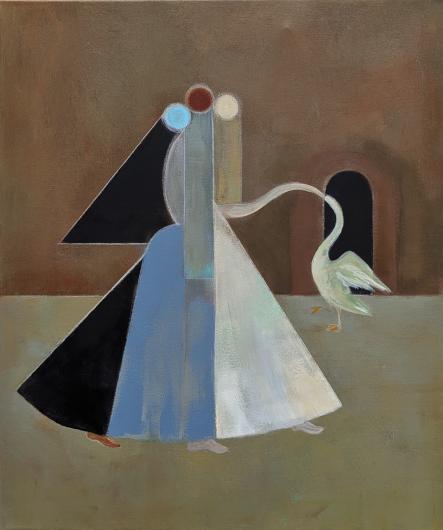
Lily Ludlow is an American artist and fashion designer known for her ethereal, dreamlike art that blends realistic elements with pure abstraction. Her core themes include stylized, semi-abstract human figures—mainly female, romantic couples and mythological archetypes—set against heavily textured canvases created with mixed media such as acrylic, chalk, pencil, and graphite. She applies multiple layers of paint, then deliberately sands or scrapes them away, creating a weathered, ghostly texture that causes the forms to fade into the background, echoing surrealist grattage.
With a current solo show at Grieder Contemporary in Küsnacht, a suburb of Zurich, the Lower East Side-based artist set aside one new painting, a surreal charmer titled The Familiar, for her New York gallery’s booth.
Image: Lily Ludlow, The Familiar, 2026.
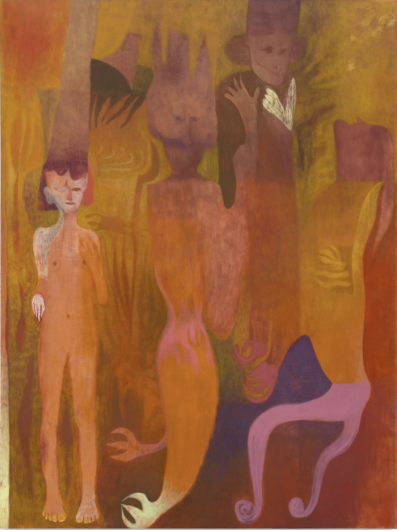
A standout painter in the 2024 Whitney Biennial, New Mexico-based Maja Ruznic fled the fighting in her homeland of Bosnia and Herzegovina with her grandparents at age 9 and later settled in California with her mother, with help from humanitarian organizations. Earning an MFA from the California College of the Arts in 2009, she began creating emotionally charged, spectral paintings and works on paper that fuse figuration with color-field abstraction, drawing on traumatic memories of the Bosnian War and Slavic myths.
With a striking solo show of paintings on view at its Basel space, the gallery presented another new canvas at the fair. Sulphur of the Restless exemplifies how her worlds are shaped by a deep intellectual fascination with Carl Jung’s concept of the shadow self—enchantingly capturing ghostly, shamanistic figures rendered in thin washes of paint as they wander through mystical realms.
Image: Maja Ruznic, Sulphur of the Restless, 2026.
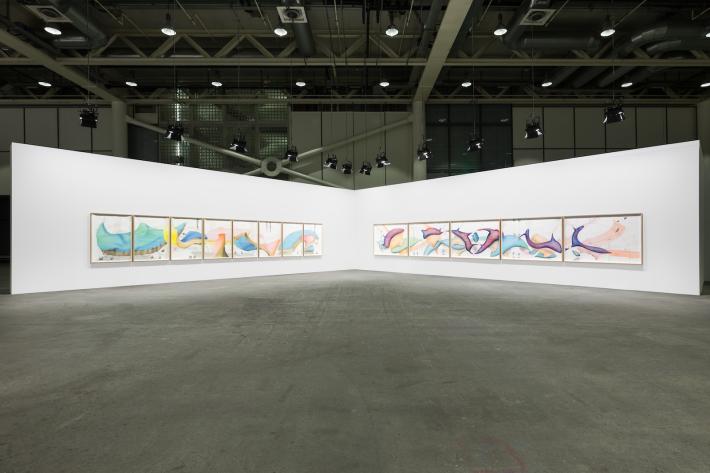
Jorinde Voigt, a renowned German multidisciplinary visual artist based in Berlin and Hamburg, is celebrated for her large-scale conceptual drawings and detailed notation systems. Her work combines elements of Conceptual Art and Minimalism, transforming complex, intangible phenomena into striking, analytical visual maps. She develops systematic thought models and experimental visual matrices to explore how inner perception connects with external reality. Her large-scale paper works, sometimes ten feet wide, feature fine ink lines, sweeping arcs, pencil marks, and energetic handwriting.
At the fair’s Unlimited sector, three of the artist’s galleries presented two movements from her widely exhibited 2016 Song of the Earth project, originally conceived as a direct response to composer Gustav Mahler's final symphonic work of the same name. Voigt employed her distinctive, calibrated drawing style to translate intricate acoustic, emotional, and existential themes—such as love, existence, and redemption—into compelling architectural visualizations.
Image: Jorinde Voigt, Song of the Earth, 2016. Art Basel Unlimited.
Paul Laster
Paul Laster is a writer, editor, curator, advisor, artist, and lecturer. New York Desk Editor for ArtAsiaPacific, Laster is also a Contributing Editor at Raw Vision and Whitehot Magazine of Contemporary Art and a contributing writer for Art & Object, Galerie, Artforum, Artsy, Ocula, Family Style, Sculpture, and Conceptual Fine Arts. Formerly the Founding Editor of Artkrush, he began The Daily Beast’s art section and was Art Editor at Russell Simmons’ OneWorld Magazine. Laster has also been a Curatorial Advisor for Intersect Art & Design and Unique Design, as well as an Adjunct Curator at P.S.1 Contemporary Art Center, now MoMA PS1.