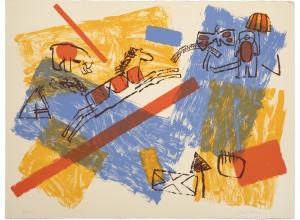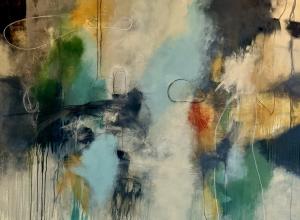

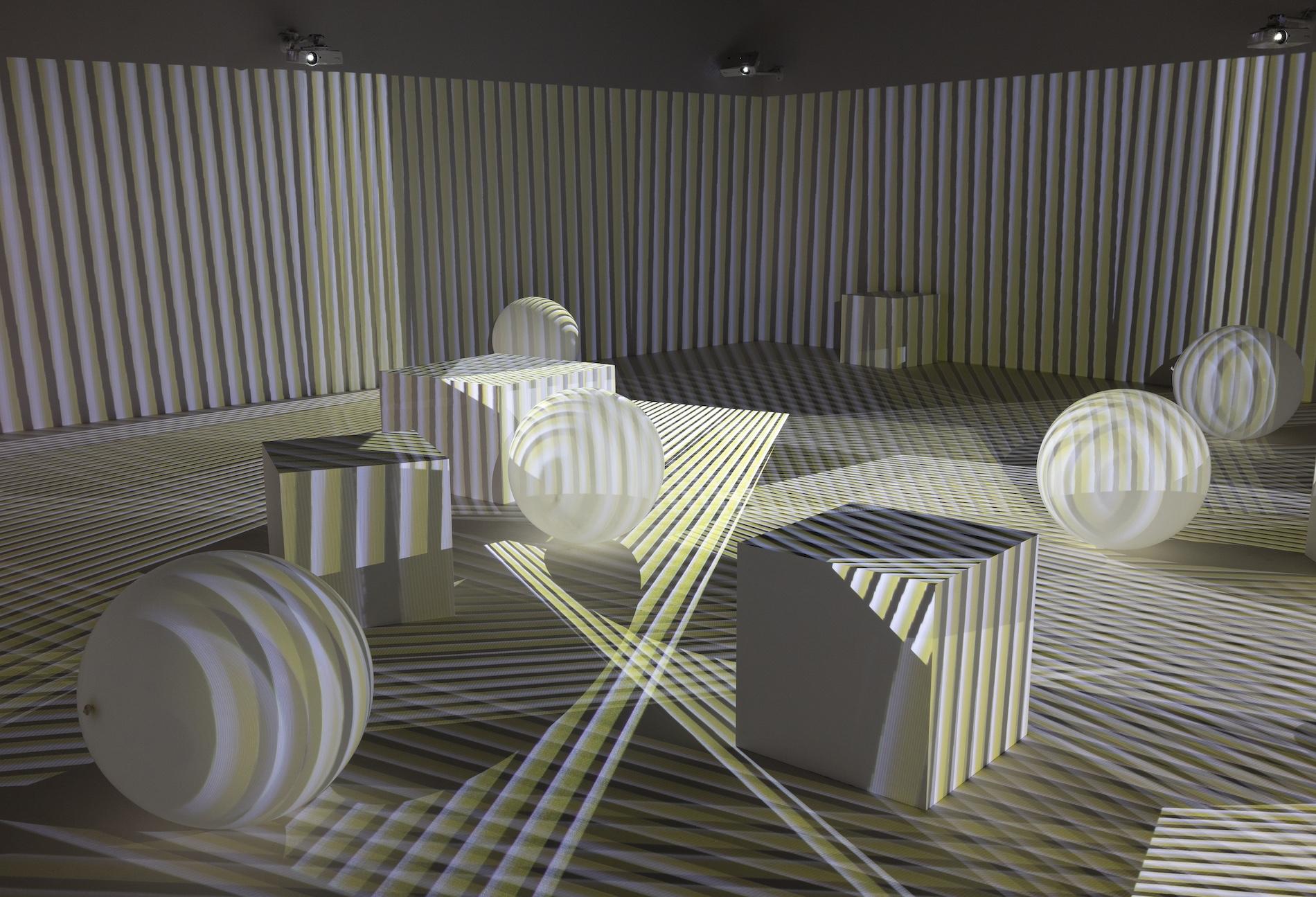
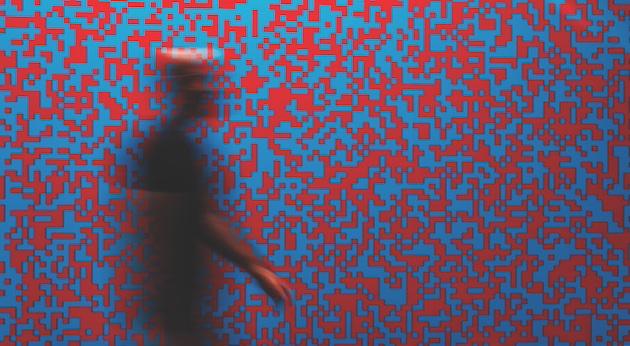
This progressive minimization of the artist could be seen as a kind of self-abnegation, a spurning of artistic ego in an embrace of pure art, the ultimate in “art for art’s sake.” The British-born artist Harold Cohen, also during the ’60s, shifted from hand-painted abstract art to computer-generated art, and ended up inventing the first AI program that could make art by itself. Cohen, a FORTRAN programmer, in 1973 wrote a “Freehand Line Algorithm”—“a set of randomising parameters which complicate the path of the lines enough to dissimulate their mechanical origin.” It sounds a bit chilling, but Cohen wasn’t looking to deceive or debase. Like many of the artists in this exhibition, he was more than a bit of a utopian. He kept plugging at AARON even after the advent of the internet era, and in 1996 wrote, “I want the work to look as if it has been made by an intelligence, but it doesn’t have to be a human intelligence. I am much happier now when I see the program produce an image that looks as if it had been made by somebody who is seeing the world for the first time: seeing the world from a different point of view than someone who grew up human.” This idea of a wide-eyed alien intelligence wondering at our world is more touching than alienating.
As the 1970s gave way to the ’80s, the personal-computer revolution gave new tools to artists who wanted to explore the creative potential of electronic graphics and new media—and provoked anxiety as well. In a conversation with the curator of Electric Dreams, British artist Suzanne Treister reports feeling “a sense of ecstasy and a sense of panic” when she first used a graphics program to “paint” on-screen. In the early ’80s, she created a series of “Fictional Videogame Stills” that challenge the seductive and militaristic allure of early shooting-oriented games. Eventually, Treister became fascinated by the history of information technology and especially cybernetics—the study of feedback loops and controls, which originated in the 1940s and became essential to the phenomenon of the Web.
Treister says, “The outcomes of imposed cybernetic systems of control depend on who and what is controlled and by whom, and, for me, in the case of Web 2.0 it raised major alarm bells.” Her discomfort with computers, the internet, and their origins in the military-industrial complex reached a point at which she felt compelled to make a large-scale artwork about the issues involved. But rather than using electronic media, she chose a very traditional one, drawing. “I didn’t want to be part of the arms race,” she says. And not only that, she chose the seemingly archaic format of a tarot deck for her series of 78 dizzyingly detailed colored drawings, the Hexen 2.0 Tarot (2011).
Ultimately, as we continue to grapple with the internet and AI and their roles in art, we will have to make sure the human factor is not lost, either to mechanism or moneymaking. A prescient manifesto written in 1968 for a meeting in Zagreb, Croatia, of an international art group called New Tendencies stated, “There are creative people in science who feel that the man/machine problem lies at the heart of making the computer the servant of man and nature. Such people welcome the insight of the artist in this context, lest we lose sight of humanity and beauty.” Something to remember, as we dream more and more of our electric dreams.