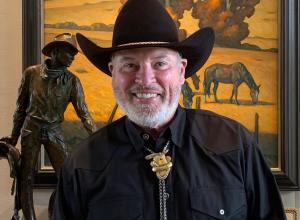
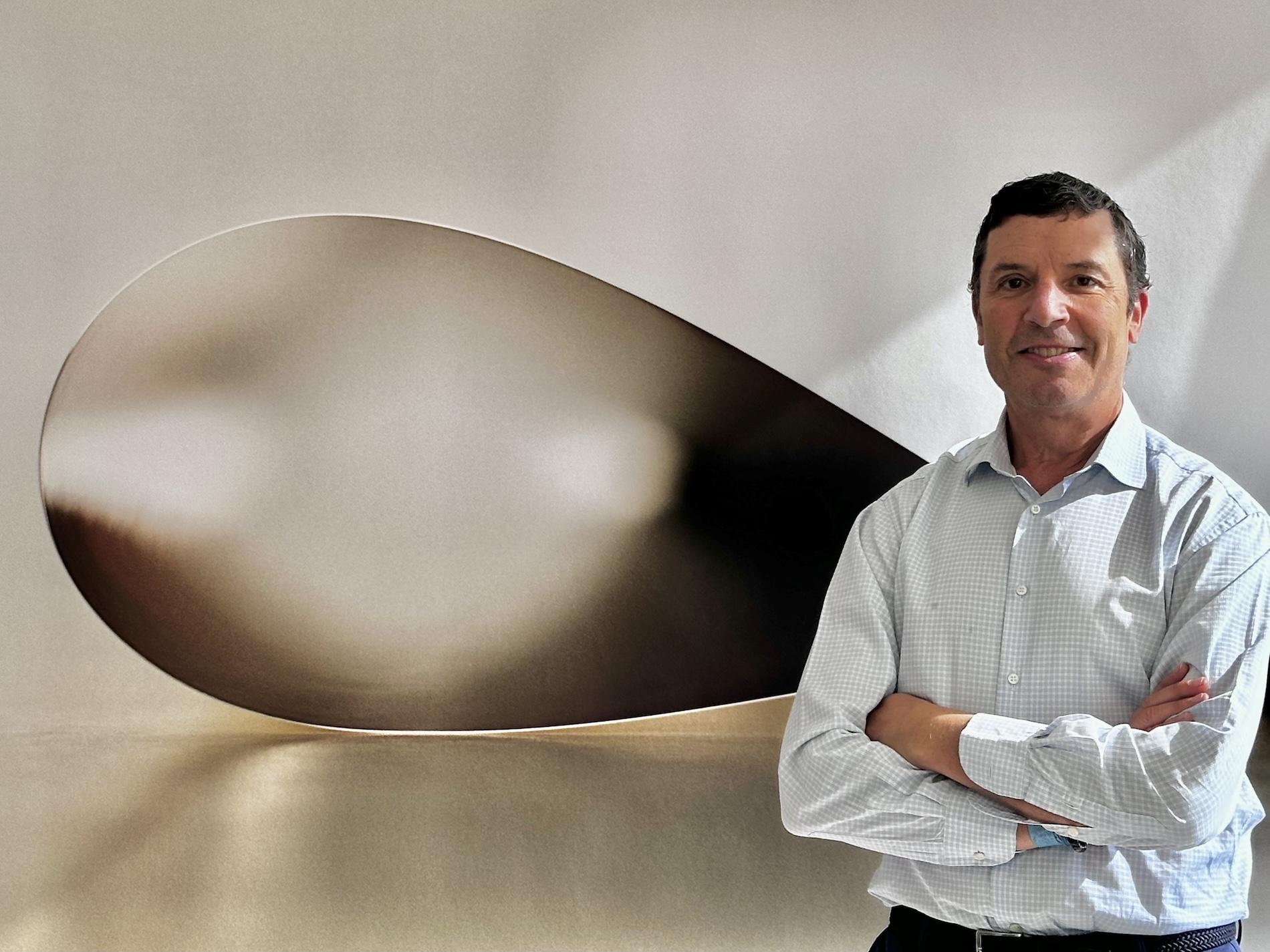
Mark Diker with Wolfgang Tillmans' Paper drop (light), 2006.
I grew up in New York with parents who were early collectors of modern and contemporary art. In the 1970s, I would accompany them to SoHo to visit galleries like Pace, Mary Boone, and Castelli. We walked cobblestone streets, stepped into raw loft-like spaces, and talked about art not as decoration but as a way of seeing and an intellectual pursuit.
At Harvard, I studied contemporary art, Surrealism, and critical theory and spent a year working in studio photography. After graduating, I lived and worked for six years in Japan, where I developed a deep affinity for the Japanese aesthetic of restraint, minimalism, and balance. When I returned to the United States, I helped a friend open his own gallery. That became my re-entry into the art world, this time as an active participant rather than an observer.
Over the past 20 years, my wife and I have built our collection collaboratively, without an advisor. We share a sensibility anchored in minimalism, abstraction, and conceptual rigor. Today the collection includes more than 75 works across painting, photography, and sculpture, and we’ve become increasingly focused on how works speak to each other across media, materials, and themes.
In photography, we are drawn to artists who expanded the medium’s language—from modernists like Harry Callahan and Robert Frank to contemporary figures like Andreas Gursky, Richard Avedon, and Shirin Neshat. Callahan’s 1957 Chicago Collage, a constellation of black-and-white squares, represents a pivotal moment in photographic abstraction. His experimentation resonates with Wolfgang Tillmans, who finds minimalist beauty in a curled piece of paper. The collection lives in dialogue. Yayoi Kusama’s Infinity Net painting resonates with the minimalism of Donald Judd’s stacked boxes, which in turn converses with Walead Beshty’s rhythmic photographic compositions. Tony Feher’s suspended glass bottles respond to Louise Nevelson’s assembled wooden sculpture and Tara Donovan’s atmospheric pin constructions. Collecting, for us, is a way of thinking—an ongoing study of form, meaning, and connection.
HOMETOWN/RESIDENCE:
New York City
OCCUPATION:
Investment Management
MAIN AREAS YOU COLLECT:
Painting, photography, sculpture
MOST RECENT WORK YOU BOUGHT:
Loie Hollowell's Mother's Milk from Pace Gallery. We love the composition, hard-edge graphic, colors, and elements of abstraction. The sister piece is in Crystal Bridges Museum, a great provenance that reflects the importance of this work.
THE ONE THAT GOT AWAY:
Ruth Asawa. We loved her hanging woven sculptures before she was rediscovered, but never purchased in the low six-figures when we had the opportunity 20 years ago. Many of those same pieces are now in a MoMA retrospective and have appreciated materially.
FAVORITE PIECE IN YOUR COLLECTION:
Rashid Johnson's multimedia painting, Untitled Beach Collage (2017). We love his use of materials and imagery, rich in symbolism and personal history.
YOUR ADVICE FOR NEW COLLECTORS:
Love what you collect and want to live with, not what you think is important. Be thematic, so that your collection has a composition and dialogue. Better to have one great piece than many lesser ones. Quality is key, so focus on that rather than getting a "B" piece by a desirable artist. Spend a lot of time going to museums, galleries, and art fairs, learning, and enjoy the journey.
Mark Diker is the CEO of Diker Management LLC and Nextlight Fund LP, and an Executive Fellow at Harvard Business School.
*This article originally appeared in Art & Object Magazine's Winter 2026 issue