Fair  December 11, 2025  Paul Laster

Highlights from Art Basel Miami Beach 2025

Created:
Author: abby
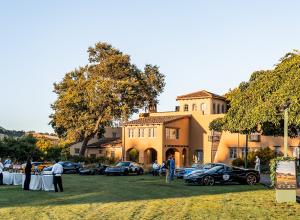
Courtesy Art Basel

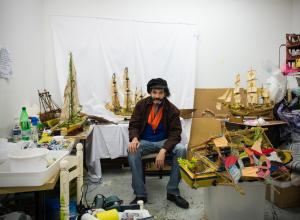
Beeple Studios. 

Featuring 283 top galleries from 43 countries and territories, the 2025 edition of Art Basel Miami Beach returned to the Miami Beach Convention Center from December 3 to 7, welcoming over 80,000 visitors— including representatives from more than 240 museums and foundations— during its VIP and public days. Hosting private collectors and patrons from the Americas, Europe, Asia, Africa, and the Middle East, the fair emphasized Art Basel Miami Beach's role as the leading market and discovery platform for modern and contemporary art in the Western Hemisphere.

"Looking back on the 2025 edition, I am thrilled by the energy, ambition, and creativity that reverberated within and beyond our halls,” said Bridget Finn, Director of Art Basel Miami Beach. “With standout presentations, innovative projects, and record engagement, the fair reinforced its leadership in the Americas and its power to influence the global art market. Through the fair's core sectors, as well as initiatives like Zero 10 and the Art Basel Awards, and our revitalized Conversations program, we celebrated diverse artistic voices— from LatinxIndigenous, and diasporic practices to emerging digital forms— creating moments of joy, discovery, and meaningful cross-cultural and cross-disciplinary exchange that will resonate well into the year ahead." 

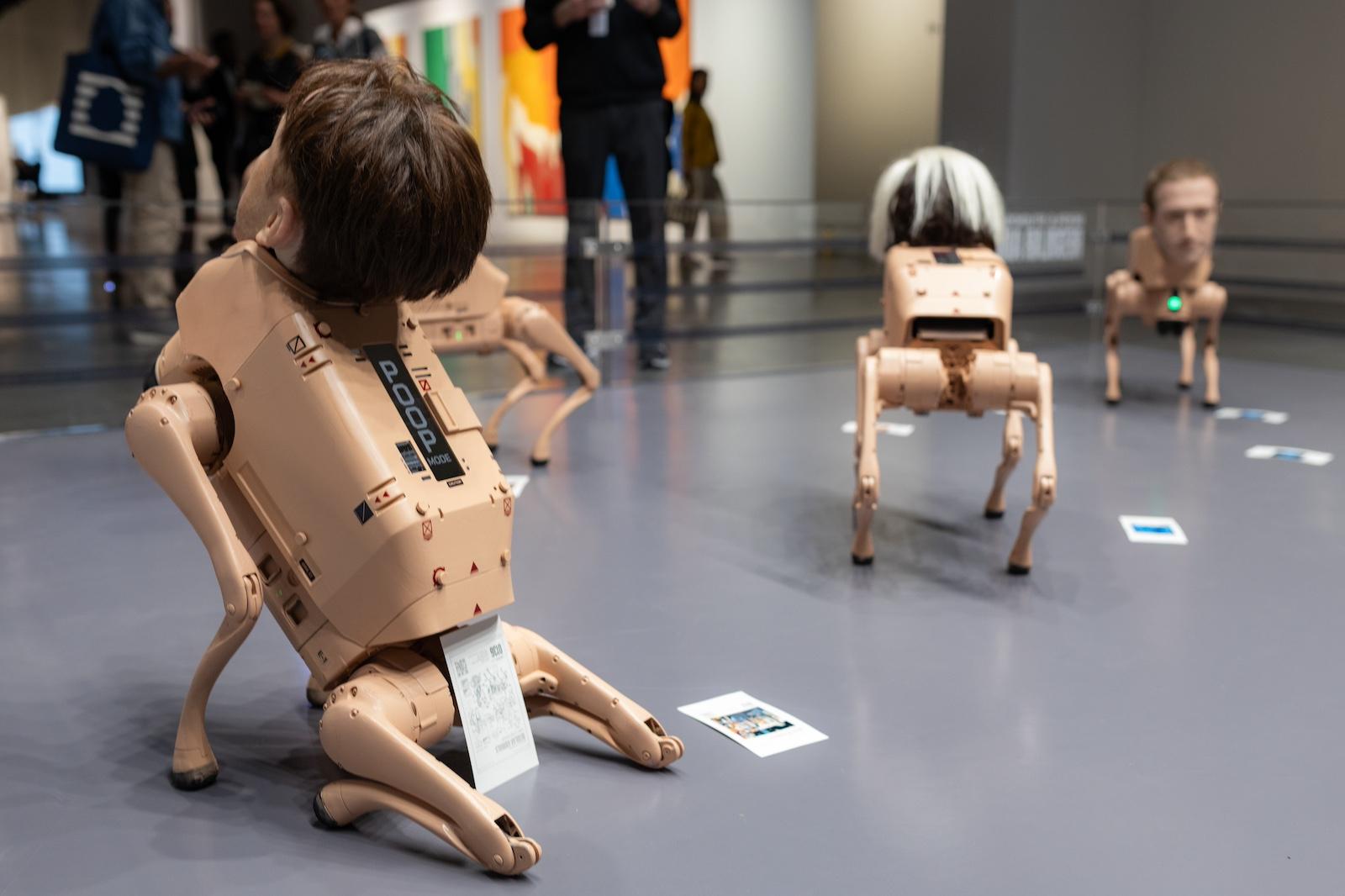
Some of the fair’s most discussed works included Andy Warhol’s 1977 painted portrait of Muhammad Ali, coincidentally shown at the place where Ali defeated Sonny Liston for the World Heavyweight title in 1964, on view at Lévy Gorvy Dayan; Yayoi Kusama’s 2016 mirror-boxed Infinity Mirror Room at Victoria Miro; Pablo Picasso’s abstracted portrait of his young daughter, Paloma, from 1951; Frida Kahlo’s 1938 miniature self-portrait at Weinstein Gallery; and Beeple’s dog pen installation featuring AI robotic dogs masked as Elon Musk, Mark Zuckerberg, and Jeff Bezos alongside Warhol, Picasso, and Mike Winkleman (aka Beeple) commenting on how algorithms shape the world, in Art Basel’s new Zero 10 digital sector. 

Looking beyond the usual suspects, Art & Object focused our curatorial lens on a selection of standout artworks by established and emerging artists who should be on every art aficionado’s list. Continue reading to find our favorite artworks from Art Basel Miami Beach 2025.
1 of 8
Courtesy A Hug From The Art World
1. Llyn Foulkes at A Hug From The Art World

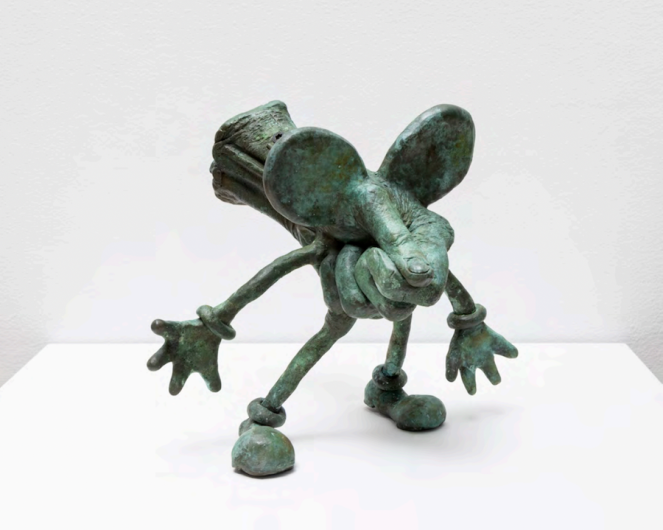
A renowned American painter, sculptor, and jazz musician, Llyn Foulkes was best known for art that provided sharp social commentary. Critiquing corporate America, the commodification of culture, and political foolishness— often through dark humor and a fiercely original, anti-establishment perspective— the Los Angeles-based artist, who passed away in November 2025 at age 91, often targeted large corporations, notably the Walt Disney Company, as symbols of the commercialization of American life, with Mickey Mouse frequently appearing in his works. The 2024 bronze sculpture Mickey Hand, a self-portrait cast in four unique patinaed versions, was fabricated for the late-career retrospective Foulkes had at A Hug From The Art World in New York in November 2024. 

Image: Llyn Foulkes, Mickey Hand, 2024, Cast bronze, 8 x 8 x 8 inches, 20.3 x 20.3 x 20.3 cm, FOULK 2024.001, Edition of 3 + 1 AP 

2 of 8
Courtesy of the artist and Vielmetter Los Angeles
2. Karl Haendel at Vielmetter Los Angeles

Celebrated for his labor-intensive, realistic black-and-white drawings and installations of cultural imagery that capture the spirit of the times, Karl Haendel is known for appropriating and recontextualizing found images, poetically blending them with his personal compositions. Creating new narratives, he affixes his drawings— both small and large— directly to gallery walls and displays them on handmade cardboard pedestals to form a gesamtkunstwerk, or complete work of art. 

Great Ass at The Met 1 is part of a series of drawings Haendel made after visiting New York’s Metropolitan Museum of Art. In search of the finest male asses from antiquity, he photographed the sculptural figures in the Met’s collection with his iPhone. He then meticulously drew the iconic butts with pencil on paper in his Los Angeles studio— turning the project into not only an exquisite suite of drawings but also a limited-edition book.

Image: Karl Haendel, Great Ass at The Met 1, 2024, Pencil on paper, 30" x 22" [HxW] (76.2 x 55.88 cm), Gallery Inventory#HAE716, Signed, dated and titled on verso

3 of 8
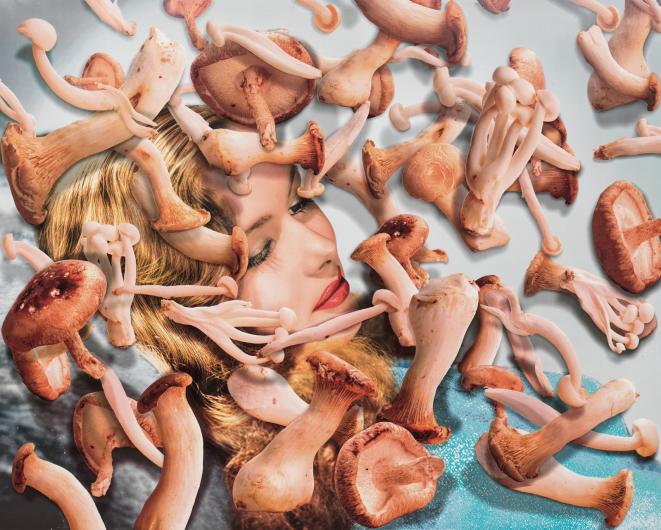
© Urs Fischer, Photo: Maris Hutchinson, Courtesy Gagosian
3. Urs Fischer at Gagosian

Urs Fischer, a renowned Swiss artist, is widely recognized for his provocative, large-scale installations, paintings, and sculptures exploring themes of impermanence, transformation, and the relationship between everyday objects and art history. Avoiding simple labels, he moves seamlessly between sculpture, painting, photography, and digital art, often using unconventional materials. 

His ongoing series of large collageProblem Paintings, features vintage Hollywood headshots layered with images of everyday objects, silk-screened over the faces, obscuring the celebrity portraits. The New York and Los Angeles-based artist’s 2025 painting Swimmer shows 1940s film star Veronica Lake trying to stay afloat in a sea of mushrooms— a striking yet ironic scene, especially considering that the seductive cinematic femme fatale died at 50 after years of overindulgence with alcohol and drugs.

Image: Urs Fischer, Swimmer, 2025, Aluminum panel, aluminum honeycomb, polyurethane adhesive, epoxy primer, gesso, solvent-based screen printing paint, and water-based screen printing paint, 76 3/4 x 96 inches (194.9 x 243.8 cm)

4 of 8
Photo: PaulSalveson, Courtesy the artist and Roberts Projects
4. Betye Saar at Roberts Projects

A grand dame of assemblage art, Betye Saar studied art and design in college, but the style of sculpture that has made the 99-year-old artist internationally celebrated wasn’t something that she learned in school. Assembling found objects into marvelous, poetic works of art, Saar has confronted issues of mysticism, racism, and feminism throughout her life. 

“I’m a maker of objects— assemblage, collage,” Saar said in a recorded tour of her studio in 2016. “I will go to a flea market, thrift store, or an antiques store and just wait for an inspiration to come from an article that I find… I like using an ordinary object and changing the meaning of it.” And, the Art Basel Awards medalist’s 2025 sculptural installation, Seeking the Promise, accomplishes just that. Featuring an upright, vintage rowboat filled with found objects, it assembles an electronic supply display cabinet, a clock face, a wooden washboard, a rustic carved wooden stool with jaguars, cow bones, and deer antlers— a mystical mode of travel to a promised land.  

Image: Betye Saar, Seeking the Promise, 2025, Mixed media assemblage, 75 x 51 x 27 in (190.5 x 129.5 x 68.6 cm)

5 of 8
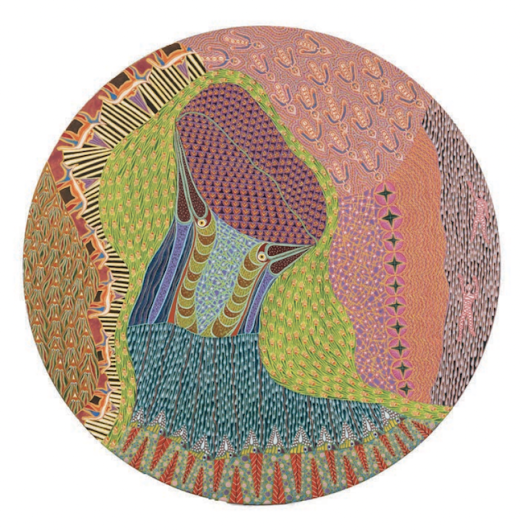
Courtesy Andrew Eedlin Gallery
5. Domenico Zindato at Andrew Edlin Gallery

Living and working in Cuernavaca, Mexico, Domenico Zindato is a self-taught Italian artist and experienced draftsman renowned for his detailed, vibrant, and contemplative abstract artworks. His creative process is labor-intensive, inspired by his travels across India and Mexico, as well as diverse cultural influences such as Aboriginal and Native American art, Buddhist mandalas, and Oaxacan textiles. He starts a piece by applying pastel to the surface with his fingers, then adds intricate patterns using fine-haired brushes and nib pens. This process, which may take months for a single significant work, is a meditative practice often done in a near-trance state for hours each day. 

With a current solo show at Andrew Edlin in New York, the gallery displayed a selection of new works, including the striking 2024 tondo At Exercises’ End / An Indistinct Nothing / A Luminous Elation / A Soul And A Soul / Through, featuring patterned parcels of hands, stars, hearts, fish, and birds flowing through a circular realm like water running through streams, offering a symbolic aerial view of life on Earth.

Image: Domenico Zindato, At Exercises’ End / An Indistinct Nothing / A Luminous Elation / A Soul, And A Soul / Through, 2024, Acrylic, inks, Flashe on canvas, 20 x 20 inches

6 of 8
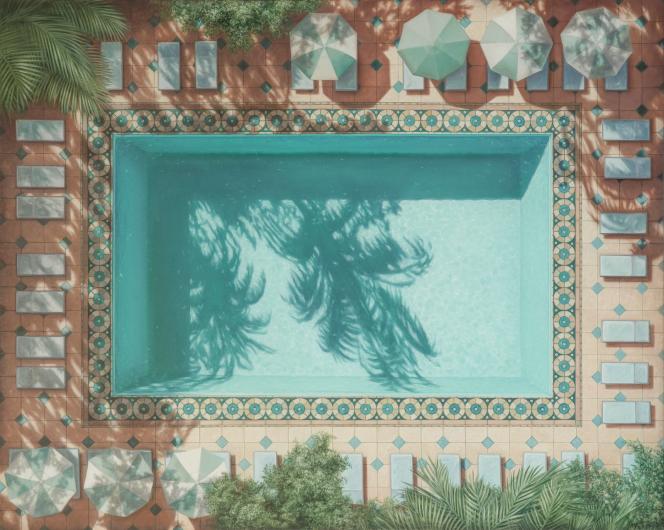
Courtesy LOHAUS SOMINKSY
6. Melanie Siegel at LOHAUS SOMINSKY

Melanie Siegel is a contemporary German artist recognized for her carefully crafted oil and acrylic paintings that explore the relationship between human-made environments and nature. By combining architectural forms with natural vegetation, she creates a subtly ambiguous space that straddles the line between utopia and dystopia. She often uses photographs of real locations as starting points, then adjusts shadows and perspectives during painting to create semi-fictional or surreal scenes. 

The Munich-based artist's 2025 painting Poollandscape was showcased by the gallery in a solo exhibition featuring related canvases, two lounge chairs, and sand scattered on the floor at the bottom of the booth’s three walls. This setup offered a metaphorical escape from the art fair, visually transporting visitors to more exotic realms— a peaceful place completely free of other people.

Image: Melanie Siegel, Poollandscape, 2025, Signed and dated, acrylic and oil on canvas, 120 x 150 cm, 47 1/4 x 59 in

7 of 8
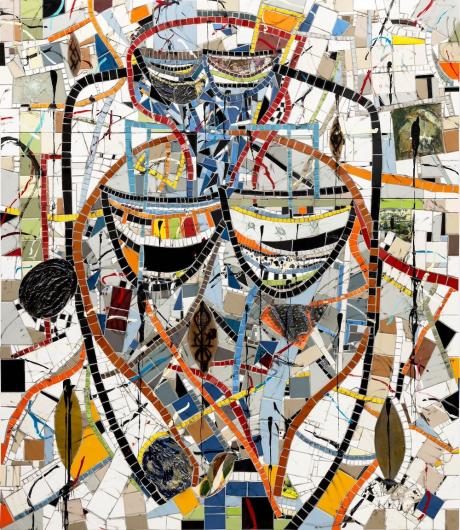
© Rashid Johnson, Photo: Stephanie Powell ,Courtesy Hauser & Wirth
7. Rashid Johnson at Hauser & Wirth

The youngest artist in the Studio Museum in Harlem’s influential 2001 exhibition Freestyle, Rashid Johnson embraced curator Thelma Golden’s concept of “post-black” culture more than any other artist in that show. Nearly 25 years later, Johnson’s multimedia work has grown to include a wide range of everyday materials and objects while exploring different ways to express his experience as an African American. 

Celebrated for his use of unconventional materials and symbolic motifs, the Chicago-born, New York-based artist is best known for his Anxious series, including Anxious Men and Anxious Audiences, which visually express personal and collective anxiety. Starting in 2015, the Anxious Men series inspired Johnson to create mosaics with broken ceramic tiles and other symbolic materials, such as black soap, mirrors, and shells. His 2025 ceramic tile montage, Standing Broken Soul “Nowhere Man”, combines these materials with spray paint, oil stick, walnut, wax, and bronze to form a fragile figure nearly falling apart, symbolizing the struggles of Black men navigating modern society.

Image: Rashid Johnson, Standing Broken Soul “Nowhere Man”, 2025, Ceramic tile, mirror, spray enamel, branded black walnut, oyster shell, oil stick, black soap, wax, bronze, 246.4 x 216.5 x 10.2 cm / 97 x 85 1/4 x 4 in

8 of 8
Courtesy Xavier Hufkens
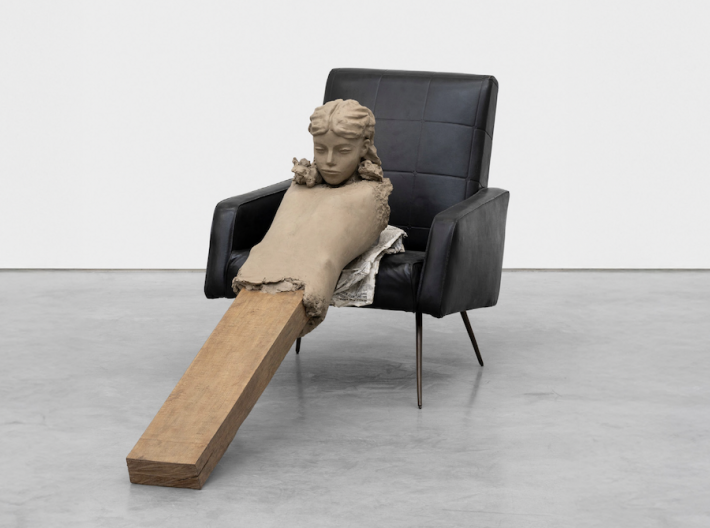
8. Mark Manders at Xavier Hufkens

A Dutch artist known for creating figurative bronzes that resemble wet, cracked clay sculptures, Mark Manders uses objects and architectural space as a unique language to explore a fictional, self-reflective identity. He describes his process as "write with objects," in which each item functions as a "frozen" word within a nonlinear, poetic sentence. Although he initially aspired to be a writer, he started creating art at age 18. Since then, the Belgium-based artist has gained international recognition, including representing the Netherlands at the 2013 Venice Biennale

Using a trompe-l’œil technique, Manders crafts almost all the objects in his work himself, rather than using found objects. The chair, scaled down to 88% of its normal size to disorient viewers' perceptions, the newspaper containing existing English words, and the piece of wood in Ramble Room Chair from 2010-2025 all appear as if they have just been crafted and left behind by their creator. Constructing a tension between permanence and transience, the work serves as a metaphor for the mind's nonlinear, rambling processes.

Image: Mark Manders, Ramble Room Chair, 2010-2025, edition of 3, patinated and painted bronze, offset print on paper, 85 × 65 × 180 cm, 33 1/2 x 25 5/8 x 70 7/8 in 

About the Author

Paul Laster

Paul Laster is a writer, editor, curator, advisor, artist, and lecturer. New York Desk Editor for ArtAsiaPacific, Laster is also a Contributing Editor at Raw Vision and Whitehot Magazine of Contemporary Art and a contributing writer for Art & Object, Galerie, Artforum, Artsy, Ocula, Family Style, Sculpture, and Conceptual Fine Arts. Formerly the Founding Editor of Artkrush, he began The Daily Beast’s art section and was Art Editor at Russell Simmons’ OneWorld Magazine. Laster has also been a Curatorial Advisor for Intersect Art & Design and Unique Design, as well as an Adjunct Curator at P.S.1 Contemporary Art Center, now MoMA PS1.

Art and Object Marketplace - A Curated Art Marketplace