

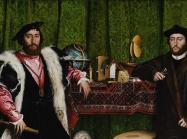


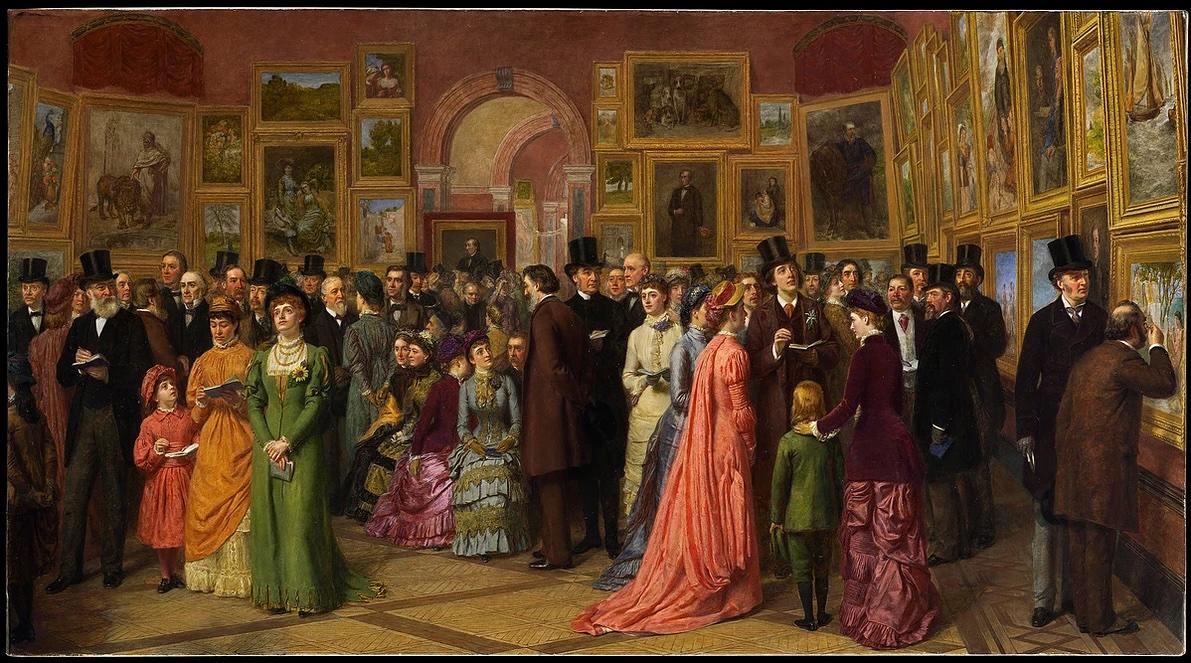
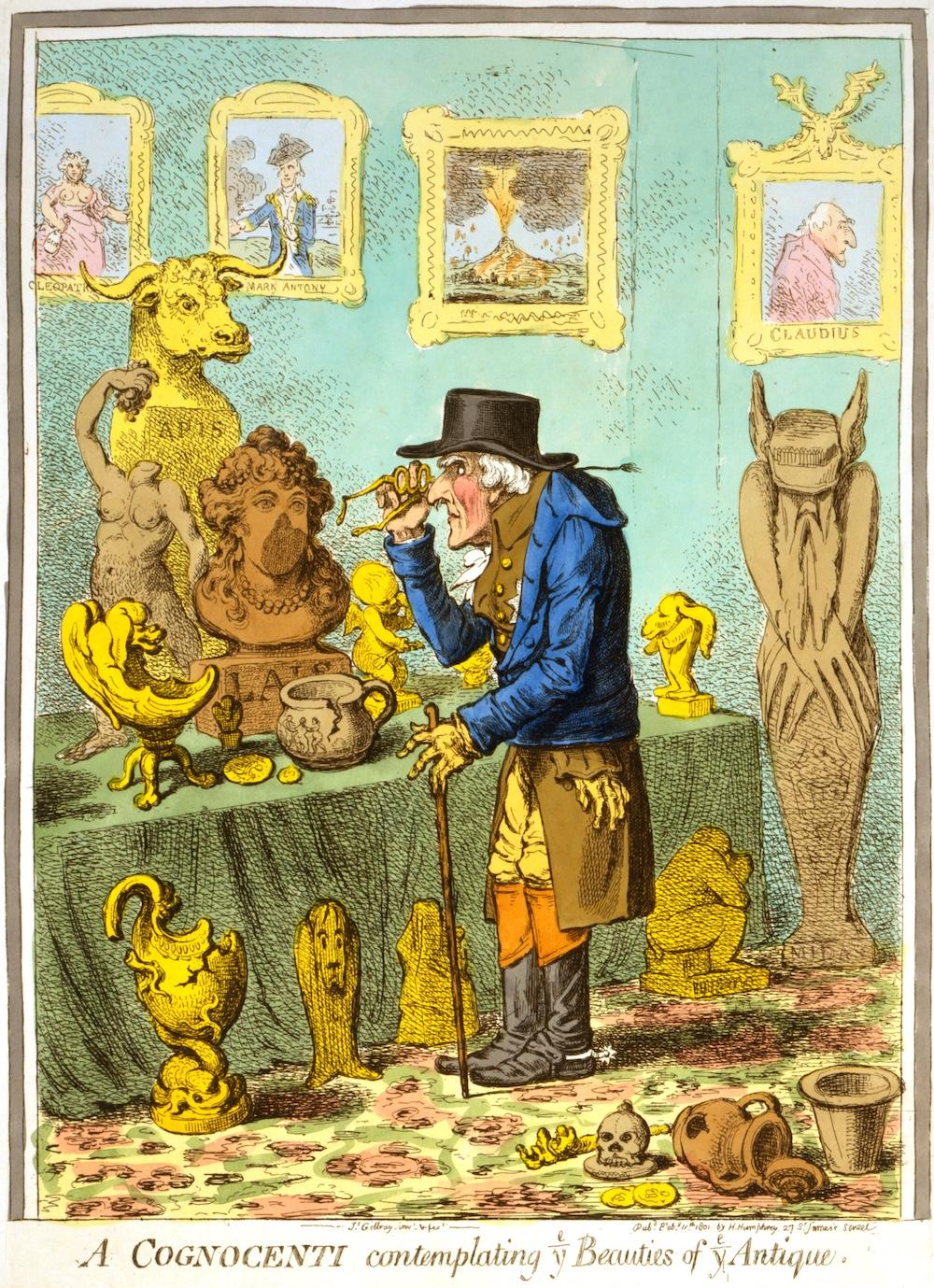
Historically, the term “connoisseur” labeled a particular type of devotee with finely tuned senses. In his 1719 text “Two Discourses,” the portrait painter and essayist Jonathan Richardson defined the three key aims of the connoisseur. According to Richardson, the connoisseur makes judgments of quality, assigns hands or authorship, and distinguishes originals from copies based on stylistic attribution or morphology. The connoisseur is an individual with a unique visual memory as well as specialized knowledge that serves to document their authority.
This newly minted expert on the art scene responded to an expanding roster of 18th-century collectors as well as—by the end of the century—the rise of public museum collections. Curators were also soon viewed as professional connoisseurs in an institutional setting. In the early 19th century, connoisseurship paralleled the rise of art history as an academic discipline. Major figures such as Giovanni Morelli (1816-1891), who devised a mode of diagnostic review, helped further codify the work, paving the way for early 20th-century connoisseurs such as Bernard Berenson (1865-1959), who helped establish the schools of Italian Renaissance art and played a key role in encouraging American collecting acquisitions of work from the era. But, by the second half of the 20th century, the rise of other art-historical methodologies and, in the case of authentication, new technologies served to diminish connoisseurship’s position.
In today’s art world, connoisseurship is tainted by connotations of elitism and viewed by many as outmoded due to its entrenchment in a canon of art that has historically been less than inclusive. It is both at the heart of art world practice and regarded as a dirty word. Mari-Claudia Jiménez, former Chairman and President of Sotheby’s auction house and now Partner and Head of Withers Art Advisory, says, “Connoisseurship has always been the basis upon which the art world has turned. But it’s also the thing that has made the art world seem very elitist. The majority of the world doesn’t understand that there are some people who have this skill and ability to be able to determine, for example, which is a Picasso, which is not a Picasso. These things make the art world seem so opaque and lacking in transparency.”
What’s more, connoisseurship’s continued relevance has been called into question by the rise of new science-based modes of authentication. Why rely on potentially faulty expert judgments when a lab technician or AI platform can render those same decisions potentially free from subjective error? In an era when technology and artificial intelligence have made great strides in their applications for art authentication, what role can traditional methods such as connoisseurship serve?
Defenders of connoisseurship today see the practice as one part in a larger puzzle, an approach to understanding works of art that must work in tandem with scientific analysis, provenance research, and other modes of understanding. John Daab, a Certified Fraud Examiner, wrote in a recent essay, “The role of the connoisseur is not to jump ahead to be the leader, but to be a team player and contribute to the process. Connoisseurship should no longer be assumed to be the prime agent of the authentication process but a significant part of the process.”
In terms of authentication, scientific analysis is typically a first step in the process, although it still engenders some doubt. For instance, lab reports on pigment analysis might suffice to label a work as a forgery if findings indicate the use of pigments then not available on the market. The 2011 sentencing of German art forger Wolfgang Beltracchi hinged on chemical analysis reports that found at least one pigment that had not yet been invented during the lifetimes of the modernist artists whose works he copied, such as Max Ernst and Fernand Léger. When it comes to purported works by Jackson Pollock, after the closure of the Pollock-Krasner Foundation’s authentication committee in 1996, high-profile cases have pitted pigment analysis against expert opinion, and many paintings remain undetermined or contentious.
Intellectual property attorney Stephen J. Frank and art historian Andrea Frank are the founders of Art Eye-D Associates. Their company uses a self-designed convolutional neural network (or CNN) to provide analysis of works of art for questions of attribution and in support of scholarship and research. In their 2022 article “Complementing Connoisseurship with Artificial Intelligence,” the Franks emphasize that their CNN is only as smart as the training data provided—data that is the result of years of human, not AI, scholarship. They write, “AI based classifications are most reliable when corroborated or illuminated by traditional scholarship or other modes of scientific analysis.”


















.webp#/media/File:William_Powell_Frith_-_'A_Private_View_at_the_Royal_Academy,_1881'_(Martin_Beisly_Fine_Art).webp)

