

At Large  February 17, 2026  John Dorfman

What French Neoclassical Art Tells Us About Artistic Radicalism

The Horvitz Collection, Wilmington

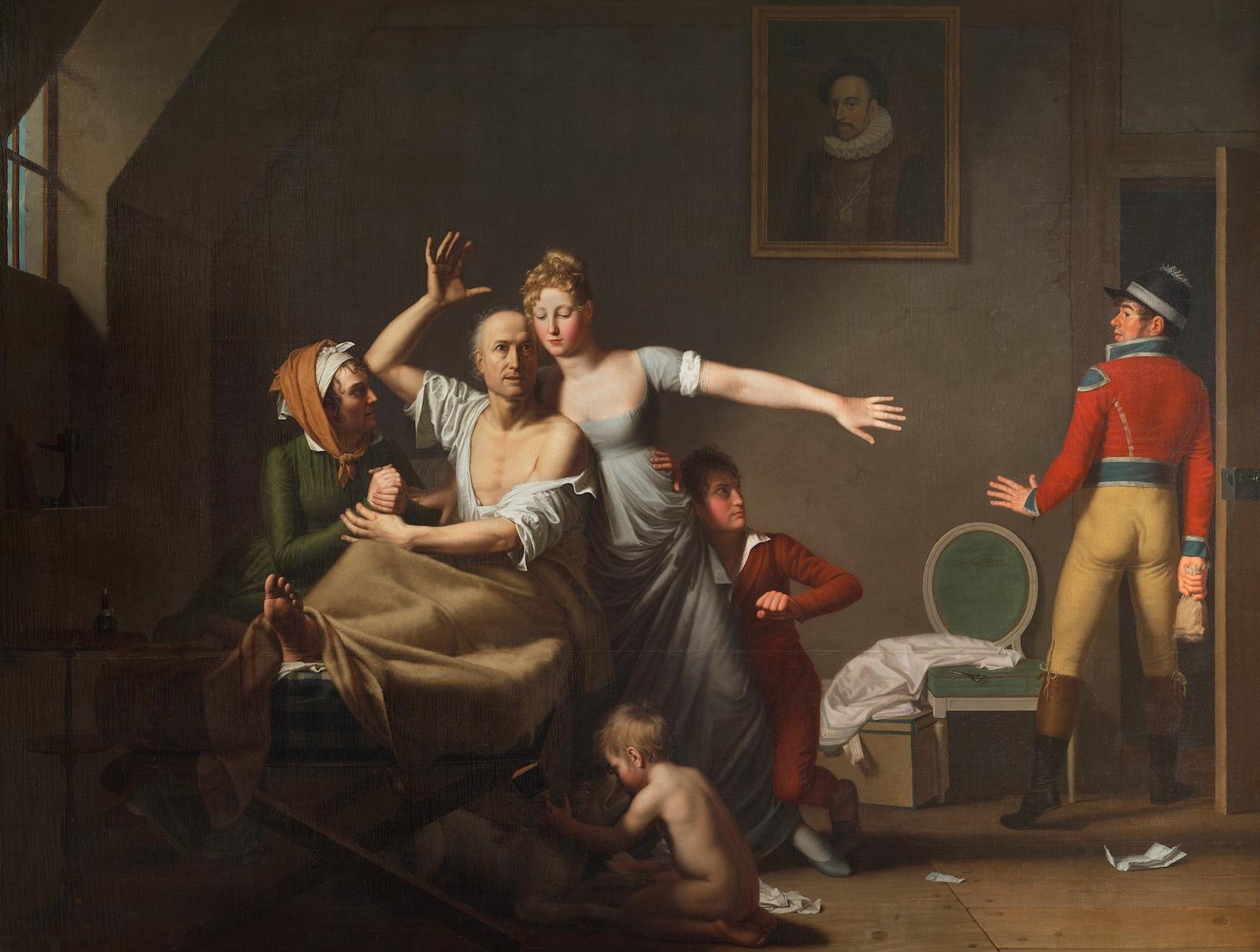
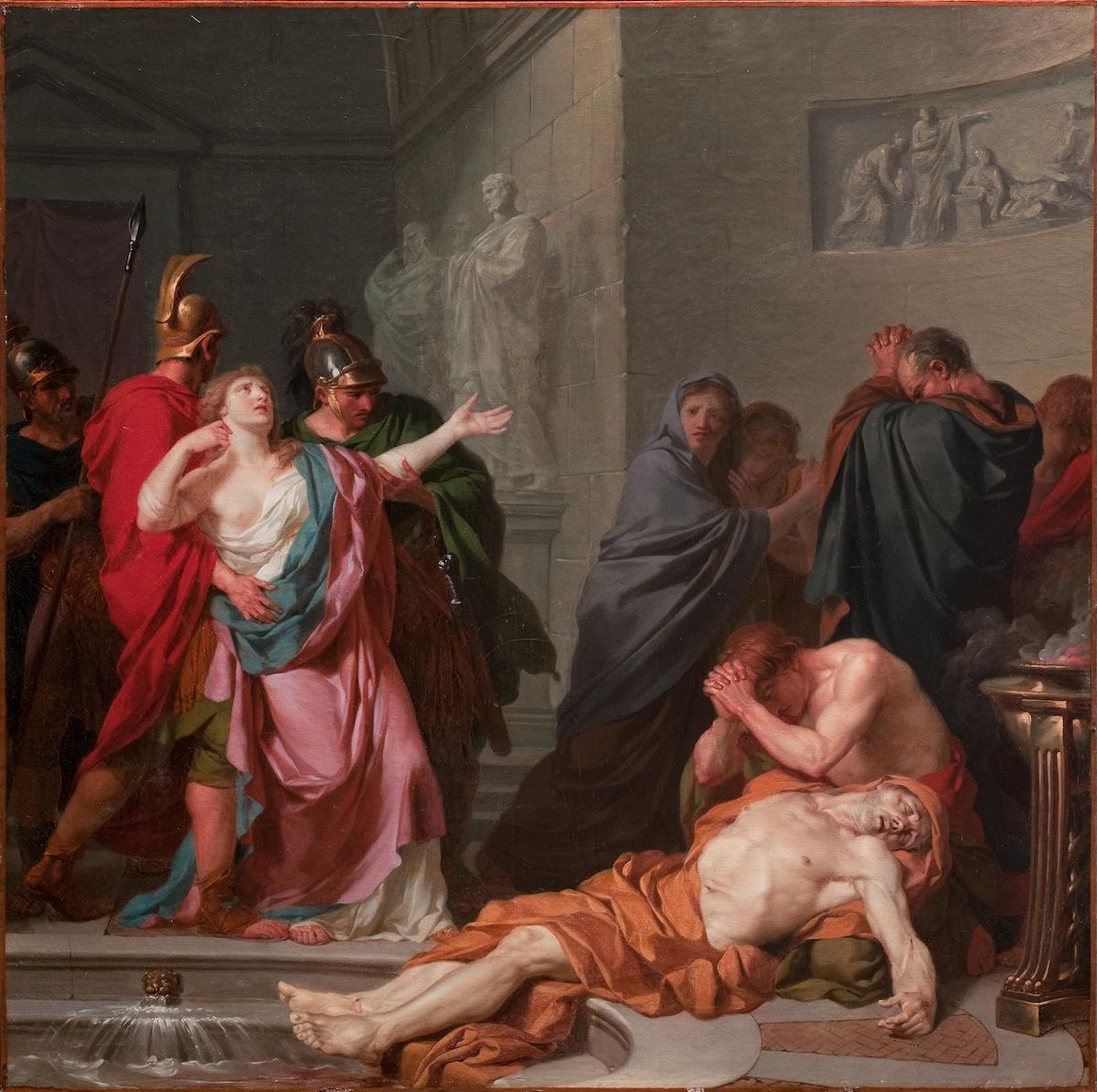
Hilaire Le Dru French, 1769-1840, Indigence and Honor, 1804, Oil on canvas, 212 × 280 cm (83 1/2 × 110 1/4 in.)

This past February, the Art Institute of Chicago became the recipient of a transformational gift, approximately 2,250 works of French art spanning the 16th through 19th centuries, said to be the largest holding of its kind in the United States. The donors were collectors Jeffrey Horvitz, a private investor, and his wife, Carol, a trustee of the Art Institute. Jeffrey Horvitz described the trove’s journey as follows: “We have always envisioned this collection remaining as a whole in order to be more than the sum of its parts, and for it to go to a major American museum where the most visitors can experience these artistic treasures, where scholars and curators can avail of the resources and advance this important research, and where our enthusiasm will resonate long after we are gone. We spent years thinking about where the collection should ultimately go—there was no more perfect choice than the Art Institute.”

While the works in the Horvitz collection—some 2,000 drawings, 200 paintings, and 50 sculptures—span several artistic eras, the focus is very much on Neoclassicism, a movement that reveled in Greco-Roman references, technical polish, and a fondness for elaborate and stagy compositions. As such they might seem out of step with present-day American tastes. Is the Art Institute’s massive new acquisition just a museological feather in the cap, of interest mainly to scholars and those with a special interest in the period, or does Neoclassical art have relevance to today’s world, artistic and otherwise? I would argue that it does, on several levels, some of them not immediately obvious.

A first glance at some of the paintings, in particular in the Horvitz Collection, makes it clear that the artists were masters of a wide variety of effects, from the rich color contrasts of Perrin’s Death of Seneca to the over-the-top staging of Monsiau’s panoramic Alexander the Great Attacking Oxyandrai and the proto-Romantic Sturm und Drang of Claude Vernet’s After the Storm or Lépicié’s Narcissus. The dramatically upraised hands of Le Dru’s Indigence and Honor and similar tableau-like gestures in many of the works remind us of the fact that these painters don’t speak our visual language. Still, we have come far enough from the dawn of Modernism to have some emotional distance from the rebellious spirit of the early and mid 20th century. The artists who grew up in the Victorian era or in its shadow rejected the aesthetics of their immediate predecessors with such passion that even decades later, critics couldn’t see Neoclassicism (or its direct descendant, Academicism) as anything but dreadful kitsch. We, on the other hand, have the freedom to appreciate it for what it is, for the most part without prejudice, and therefore can experience the technical achievements and visual power of Neoclassical painting.

One could go even further and say that in a sense, the Neoclassical aesthetic has returned or, perhaps, been reincarnated, in the contemporary art world. For the most obvious example, take a look at Kehinde Wiley’s enormous rendering of a young Black man astride a rearing white horse (in the Brooklyn Museum), an ironic homage to Napoleon Leading the Army Over the Alps by Jacques-Louis David, Neoclassicism’s heaviest hitter. Wiley even used the same title for his canvas. And while other examples may be less clearcut, there has been a resurgence of unapologetically stagy, hyper-realistic yet unreal compositions in contemporary art. Perhaps the trend toward fantasy and cosplay in contemporary culture has fed this phenomenon, but its ancestry can probably be traced back to to the Pop Art era, when artists rebelled, this time against the sober strictures of Abstract Expressionism, and asserted their right to make representational works, but without a commitment to realism, social or otherwise.

The Horvitz Collection, Wilmington

Jean-Charles-Niçaise Perrin French, 1754-1831, Death of Seneca, c. 1788, Oil on canvas, 92 × 92 cm (36 1/4 × 36 1/4 in.)

Of course, references to ancient Greece and Rome no longer speak to us in the way they did to French audiences of the late 18th and early 19th centuries. Few visitors to the Louvre who stand in front of David’s Oath of the Horatii have much idea who the Horatii were or why the incident resonated with viewers two and a half centuries ago. If anything, one might assume that reverence for the past and the ultimate “dead white male” ancestor culture is what was intended. Quite the contrary—Neoclassicism flourished during the French Revolution, and David himself was a member of the most left-wing radical faction among the revolutionaries, the Jacobins.

Neoclassicism defined itself against the Rococo style that preceded it, which the artists of the late 18th century deemed decadent. In place of Rococo’s extravagances, they championed the simplicity and severity that they believed characterized the Greco-Roman world, especially Republican Rome. In its first iteration at least, Neoclassicism stood for the rationalism of the Enlightenment, justifying and defending it by associating it with the founders of European civilization. The French Revolution grew out of the rationalist world-view promoted by Voltaire and his fellow philosophes, and while its excesses can be certainly be called irrational, the revolutionaries saw themselves as rationalists because of their opposition to the Catholic religion and the tradition-bound reign of the aristocracy. Artistically speaking, the crispness and compositional rigor of Neoclassical painting and drawing connoted rationalism; the rule-breaking expressionism of the Romantics came into vogue after the Revolution was over.

In our own era of irrationalism, the consideration of Neoclassicism in art may be more fraught than ever. Here in the U.S., President Trump has expressed enthusiasm for classicism, going as far as to call for all new federal buildings in the country to be built in a “classical” style and insisting that the sculptures for his projected “Garden of American Heroes” be created in a “realistic” manner, with no “modern or abstract” designs allowed—whatever that means. For an administration that has sought to subvert the Constitutional idea of separation of powers, militated against scientific research, and generally embraced the irrational, any advocacy of classicism, Neo or otherwise, seems highly ironic. At best, it’s an example of poorly understood aesthetics emptied of content; at worst, a cynical misappropriation of a symbolism that runs deep in our history and culture.

To be sure, Neoclassicism and its offshoots served many agendas in their day, not just revolutionary ones. Bourgeois domesticity and antique revivalism were also aided and abetted by Neoclassical art and its associated design styles. Politically speaking, the French Revolution was followed by the Napoleonic era, and many Neoclassical artists went on to glorify the emperor and align him with Greek and Roman antecedents by way of justifying his undemocratic actions.

The U.S. was born during the Neoclassical era, and the rationalism of the Enlightenment pervades our founding documents. The Napoleonic ideal didn’t catch on here. If we take the time today to look closely at Neoclassical art in a place like the Art Institute of Chicago and to appreciate its genius, it would be a good idea to contemplate, at least briefly, the various meanings that classical antiquity has taken on in Europe and America, and to seriously consider the fact that rationalism can be a powerful force for good in both art and life.

*This article originally appeared in Art & Object Magazine's Summer 2025 issue.
About the Author

Subscribe to our free e-letter!

Webform
Art and Object Marketplace - A Curated Art Marketplace