

Studio  August 4, 2026  Caterina Bellinetti

Deeply Rooted: Diana Scherer Blends Craft with Science

Courtesy of the artist

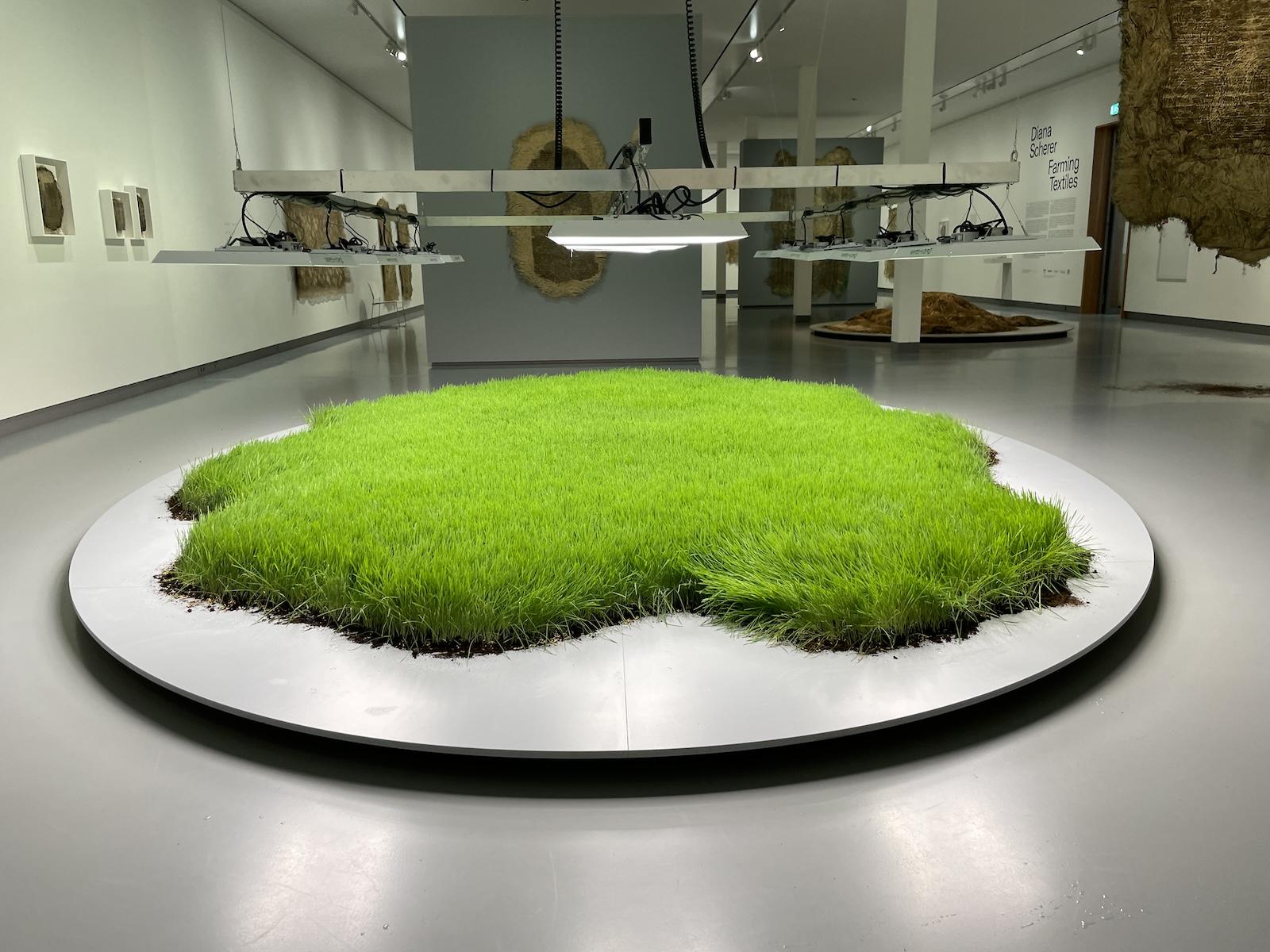
Farming Textiles installation, Museum Kranenburgh, Bergen, Netherlands, 2024.

Weaving—the process of interlacing various sets of threads—is one of the oldest and most significant forms of craft in human history. Weaving techniques were already known in the Paleolithic period and employed to make baskets, ropes, and shelter out of plants and branches. The oldest textiles, also crafted with plant fibers, were found in Peru and dated to around 10,000 B.C. 

Weaving occupies an interesting position that bridges art and craft, a distinction that often depends on the cultural context and intent of the maker. Traditionally considered a craft due to its practical utility and technical demands, weaving has also been used to express creativity through high-impact sculptural works, wall hangings, tapestries, and installations. Today, many artists around the world incorporate traditional weaving techniques into their works, highlighting their craftsmanship skills as well as their design innovations.

Photo By Tessa Posthuma De Boer

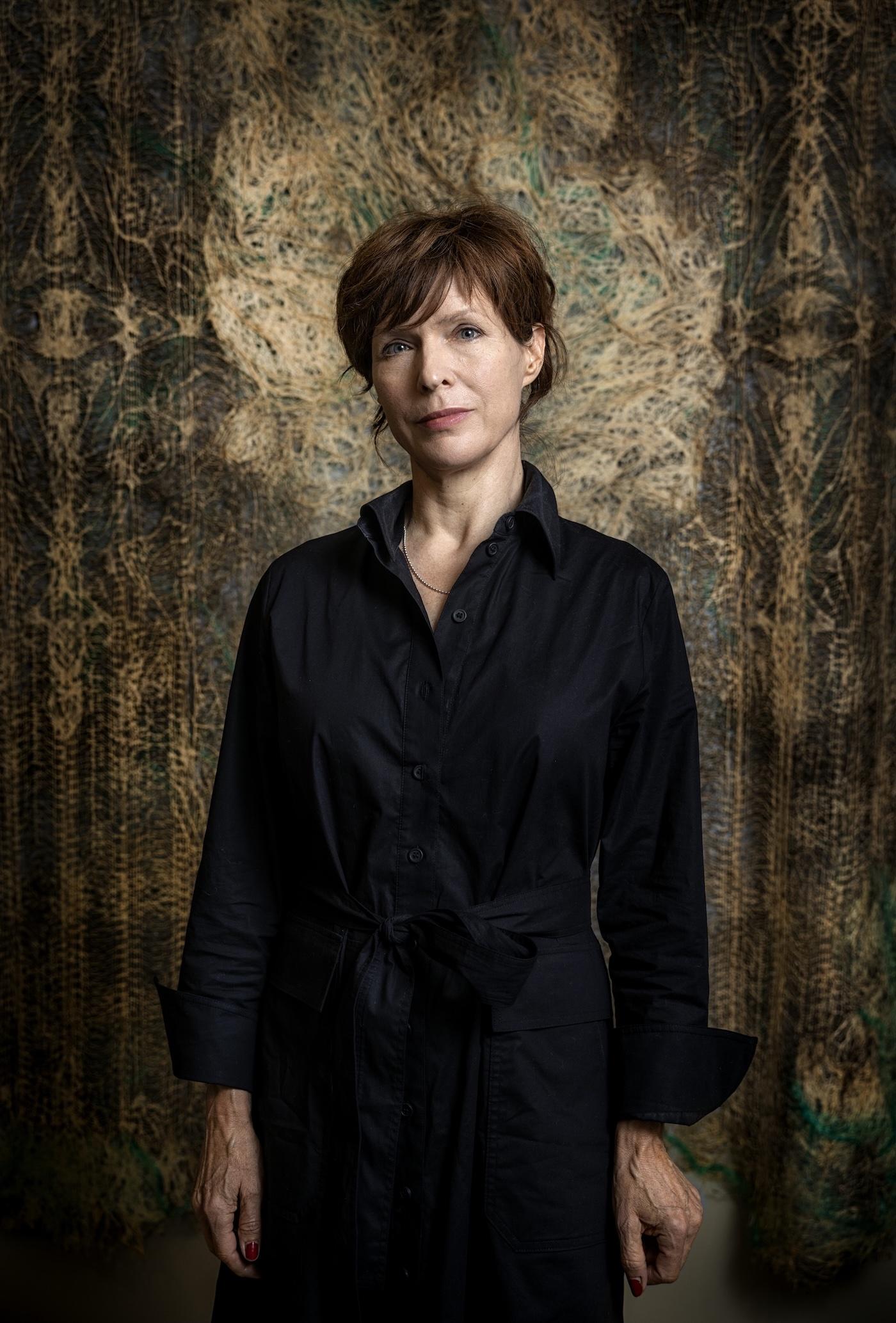
Artist Diana Scherer

One of the most compelling artists to keep a traditional craft like weaving at the core of their practice is Diana Scherer. German-born but based in Amsterdam, Scherer has developed an innovative creative process that blends weaving with botanics and science. This all began in 2012, when Scherer started exploring the “rootbound” phenomenon of plants growing in constricted spaces. After growing from seed for six months in vases, the plants were freed from their containers and photographed. Their bare roots revealed the shape forced onto them by the now-removed vase.

This series of photographs, titled Nurture Studies, inspired Scherer to see plant roots as fibers and investigate their malleability. Her ongoing project, Interwoven, explores this potential by training the roots to find water and nutrients through a template. “Through this process, the plant itself becomes both medium and collaborator; the growth of the root system is guided by a technique I devised in which the act of weaving is not imposed but emerges through the plant’s own development,” explains Scherer. “Here, cultivation is simultaneously artistic gesture, biological process, and craft practice.”

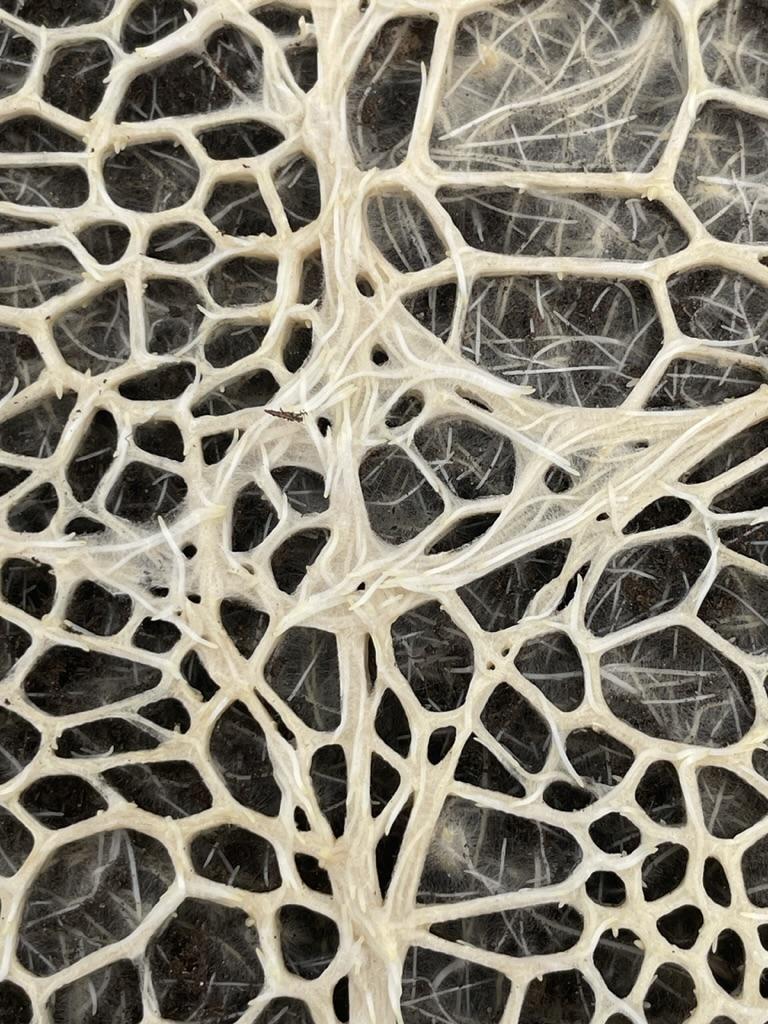
The different techniques employed result in two outcomes: a thick rug of intertwined roots in which soil is still a visible part of the design, and a thinner, drier material that resembles and behaves like fabric. Scherer predominantly uses grass seed for its strength, density, and wool-like appearance, but she also experiments with poppies, dandelions, nettles, and verbena. The designs are inspired by natural geometric patterns, such as a hexagonal honeycomb. Scherer clearly wants to remain rooted in nature for her patterns: “Nature’s principles of construction and arrangement is the theory that assumes the same elements and patterns recur again and again in every plant. I use microscopic images of plants that show cell tissues affected by climate change—for example, structures of burnt wood or plant structures mutated by flooding. I combine these structures with universal man-made signs or art forms, from bubble plastic or traces of car tires in the mud.”
Courtesy of the artist

Close-up of Interwoven.

Considering Scherer’s almost scientific approach to the project, one could wonder what it means to be an artist whose work crosses into science while incorporating a traditional ancient craft such as weaving. Scherer replies that she developed the concept of “weaving the root system” in collaboration with scientific methods. “Scientists may regard artistic interpretations as overly speculative, while art audiences may perceive scientific framing as too rigid. My practice navigates between these two worlds, seeking a space where both can coexist productively.”

This art challenges traditional boundaries by being textile art, bio-art, and scientific research all at once, while also questioning the impact that humans have on the environment. Is creation, even when it is artistic, a form of control, or can it be seen as collaboration instead? Scherer is clear in her answer, “In its original sense, to ‘cultivate’ signifies not passive allowance but an active process of discipline and shaping. Within my practice, the manipulation of root systems, reconfigured as tapestries or living sculptures, serves as a material articulation of this tension. These works make visible the traces of human intervention in natural processes, exposing the fine line between cultivation as care and cultivation as control.” 

To care, then, is the path we should consider—to balance our actions so they can become collaboration and not control, to look beyond what is visible, to go deeper and find nourishment, to patiently wait for things to grow and acquire shape. It is also an invitation to remember that this type of art, in the words of the artist, can also foster “critical reflection on the cultural narratives and ethical implications of cultivation in the Anthropocene.”

*This article originally appeared in Art & Object Magazine's Winter 2026 issue.

About the Author

Caterina Bellinetti

Dr. Caterina Bellinetti is an art historian specialised in photography and Chinese visual propaganda and culture.

Subscribe to our free art newsletter!

Webform
Art and Object Marketplace - A Curated Art Marketplace