At Large  July 21, 2026  Jordan Riefe

Bisa Butler’s Quilted Portraits Assert Love and Justice

PHOTO By Mark Woods. Courtesy of the artist and Jeffrey Deitch, New York and Los Angeles

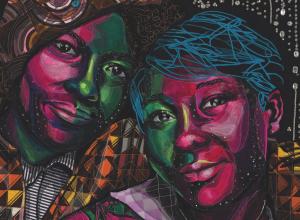
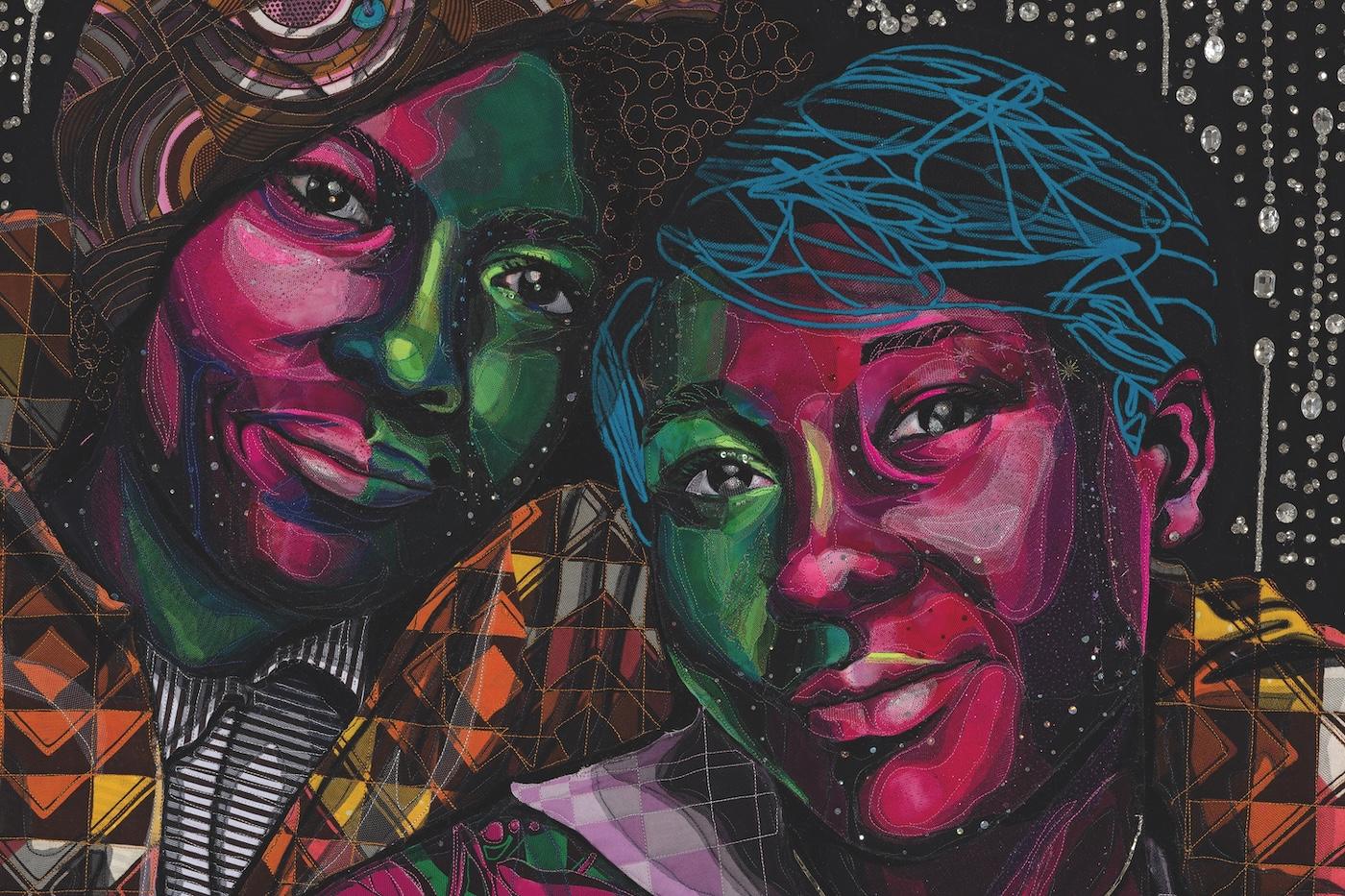
Bisa Butler, My Cherie Amour. At first glance, Butler’s fiber works look like vibrant paintings.

If it’s useful, it can’t be art. For the longest time, the art world has deemed craft as less-than. Figures like Ruth Asawa, whose suspended sculptures stem from basket weaving, took a while to catch on as experts had a hard time classifying them. Fiber artist Bisa Butler, also a woman of color, has seen her medium similarly denigrated.

“Anything having to do with craft, with women, with what was formerly done on plantation—weaving, basket-making, quilting—that is not fine art,” Butler tells Art & Object on the occasion of her show, Hold Me Close, at Jeffrey Deitch in Hollywood, which ran through November 1. “Any art that’s useful isn’t fine art. If it’s on the wall just to look at, now it’s fine art. People would ask me, ‘When are you going to stop making those blankets and return to art again?’”

A longtime gallerist, Deitch has witnessed firsthand the convolutions of the art trade, trends, and movements, representing names like Rammellzee, Keith Haring, and Kenny Scharf with galleries on both coasts. “When I first got involved with art in the early 1970s, people still debated whether photography was art,” he said in an email. “An artist like Bisa Butler has transcended the craft of quilting to create works that are equal in achievement to the work of some of our best painters.”

With anti-DEI policies being implemented by force or acquiescence at cultural institutions nationwide, and ICE roundups plaguing American cities (3,800 people in Los Angeles alone, with 65% having no former criminal record), Butler offers 11 works featuring portraits, single and in pairs, of smiling faces together in brotherhood and love.

“This show is called Hold Me Close, because that’s how I’m feeling every day. I’m looking at the news and feeling very destabilized. It’s terrifying,” she says with a shudder on a warm day in the conference room of the gallery. “What new executive order is coming down? Will my work be accepted into an institution, is my history even going to be considered African American history? So, hold me close. We need to hold tight together.”

At first glance, the works look like vibrant paintings, mainly utilizing AfriCOBRA’s (Chicago-African Coalition of Bad Relevant Artists) “Kool-Aid” color palette based on African textiles using cherry, orange, lime, bright yellow, and crimson red, in Butler’s case, applied in Fauvist fashion. Other inspirations include Faith Ringgold, who began with black canvas and painted color over it. Also impactful is Kerry James Marshall, whose color wheel included a wide variety of shades of black.

Photo by Javier Romero

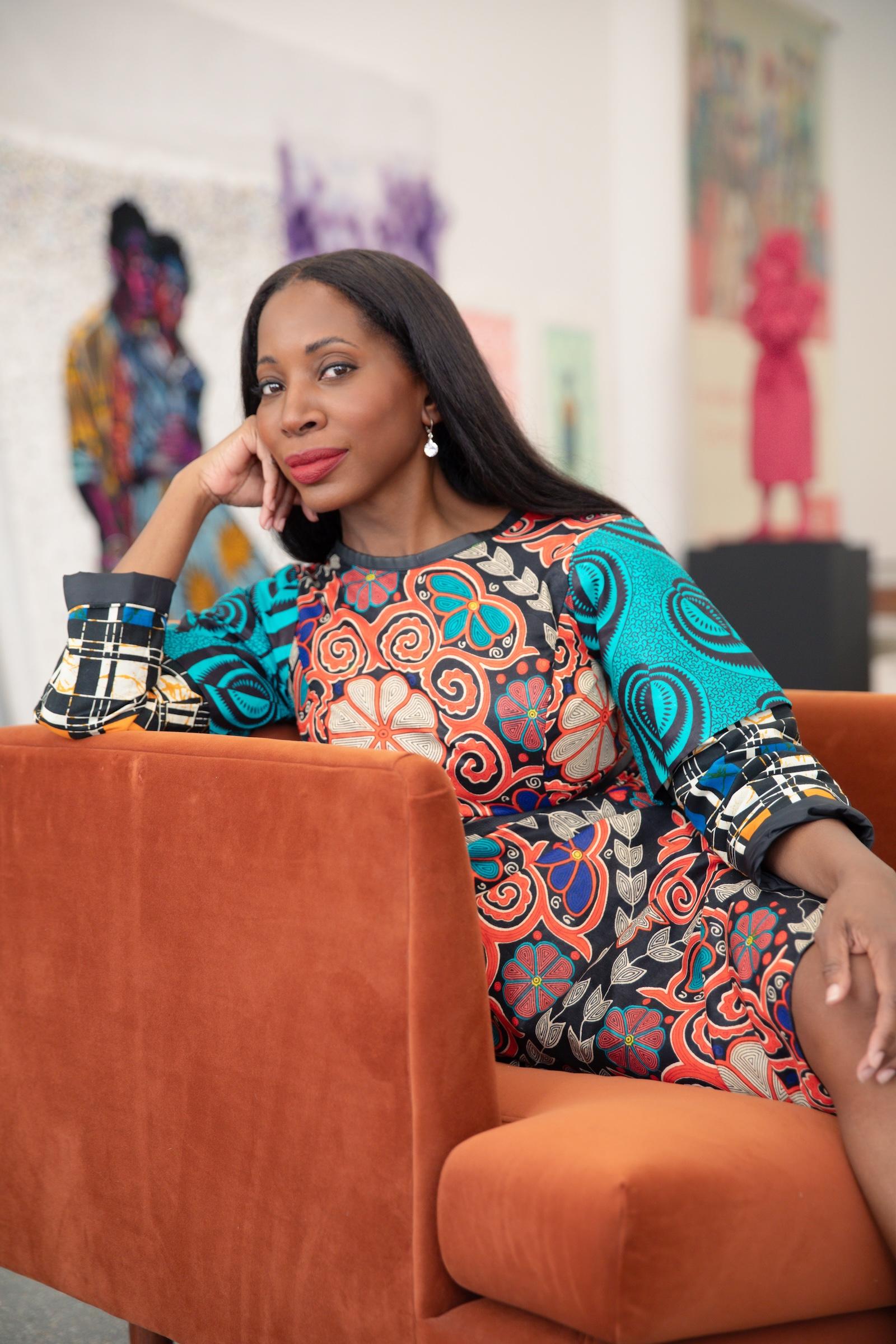
Artist Bisa Butler

“They say that black is not a color. So this is a repudiation,” says Butler, whose works might include 15 layers of fabric. “In every piece, I’m using black as a base, adding more layers than usual, using sparkly things and glitter to make the black shine through.”

In Nigeria’s Yoruba culture, red is the color of Chango, a powerful deity. Butler uses the color to depict power as in The Guardian, a portrait of a man in green leopard-skin faux fur, holding his head-scarfed daughter close, her face framed by the opening of his jacket. Above him flies the Stars and Stripes in the David Hammons colors of red, green, and black. The image is sourced from a photo (as is all her work), taken in 1990 by Earlie Hudnall, Jr. Once Butler settles on an image, she contacts the photographer and opens negotiations. Often the cost is no more than a nominal fee, though some ask for a print of the completed work.

Down, down, baby depicts two little girls playing in a ditch in front of a shotgun shack. One holds a teacup of water, which she pours into the waiting cup in the other girl’s hand. It’s based on a photograph by the great Gordon Parks, taken in Alabama for his 1956 LIFE magazine assignment, The Restraints: Open and Hidden, about life under Jim Crow. The original, titled Girls Playing in Water, has the girls standing in black, brackish water, indicating no indoor plumbing as well as risks of disease and infection. But in Butler’s rendition, the water is limpid blue, and the background is a knockoff of a pale green and lavender-pink pattern. These are colors that remind her of her children.

For Butler, quilting and sewing hold a special place in her family. Her grandmother would accompany her husband—the U.S. Emissary to Morocco in the 1950s—to state affairs in her homemade Christian Dior. Years later, Butler’s mother and aunt used to sit and sew together. It’s one reason why Butler doesn’t use a lot of quilting material, opting instead for scraps from her mom—various fabrics, tulle, or lace as components in her works.

At Howard University, Butler pursued a degree in painting, but then got pregnant and became violently nauseated by the smell of oil paint. “I was struggling in painting,” she says. “I can paint very well and realistically, but I have to draw what I see. So all my paintings were hyper-realistic, and that’s not what I wanted.”

So she stopped painting. One of her professors suggested collage and introduced her to the work of Romare Bearden. It was a course correction that eventually led to a vital and lucrative career. As a mom and struggling artist, she worked as a high school art teacher in Newark, New Jersey.

“My stuff was for me. And, all the people around me liked my artwork, so the validation was coming,” she recalls of the salad days. “One of the teachers asked me to do a portrait of her and her daughter, and she framed it. And her husband took me out to dinner.”

She finds inspiration from artists of all stripes, but relates most to artists of color. “I want to know how they survived in that era,” she says. “If I’m going to make it as a Black woman artist, I can’t look at Mary Cassatt. I can relate to Frida Kahlo, because she fought for equal rights as a woman artist and was really determined to bring in her Indigenous culture. I’m not trying to paint like Frida, but I want to know how to live a life with dignity and how to live as an activist artist.”
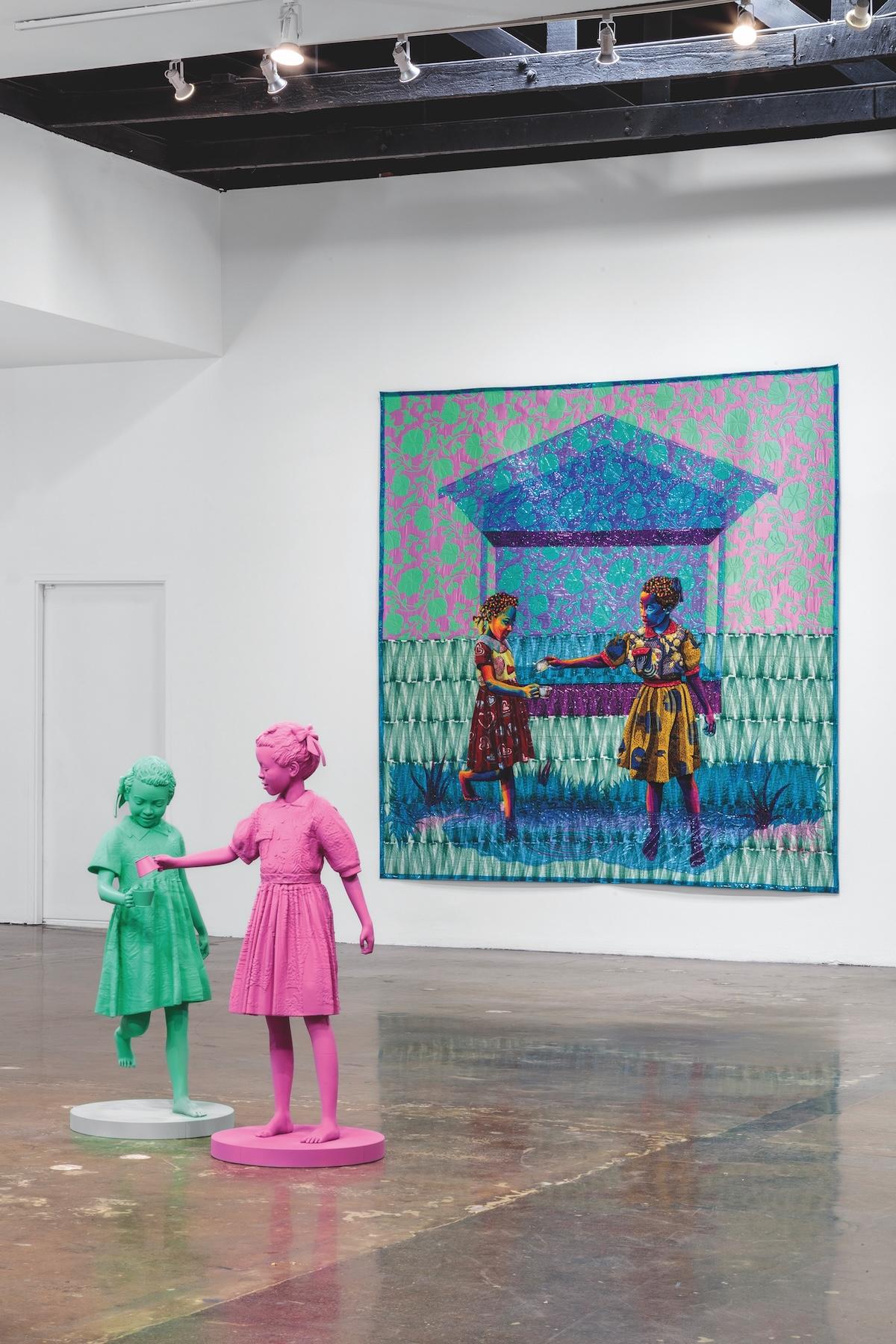
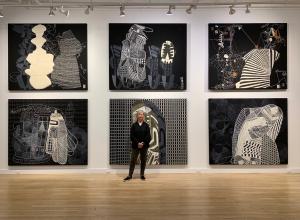
Photo by Charles White / JW Pictures. Courtesy of the artist and Jeffrey Deitch, Los Angeles

Installation view of Bisa Butler, Hold Me Close at Jeffrey Deitch, Los Angeles, September 13 – November 1, 2025.

As the government’s anti-DEI policies attempt to erase Black history, art institutions nationwide are feeling the heat. “I understand that some government-controlled institutions may be constrained, but there are enough strong independent galleries and institutions to keep going strong with our progressive programming,” says Deitch. “Bisa Butler’s work speaks to people from all walks of life, and from children to the elderly. Her contribution to culture goes beyond the fine arts; the work informs and inspires, illuminating Black history and culture and celebrating human connection.”

Butler feels an urgent need for all fair-minded people to fight back in whatever capacity they can. “As an artist, by portraying Black people with dignity, people who are poor, you are fighting back,” Butler says, noting that anyone with skills has the means to protest in one way or another. “Showing a Black family who existed in the era of sharecropping with dignity refutes the lie.”

*This article originally appeared in Art & Object Magazine's Winter 2026 issue.

About the Author

Jordan Riefe

Jordan Riefe has been covering the film business since the late 90s for outlets like Reuters, THR.com, and The Wrap. He wrote a movie that was produced in China in 2007. Riefe currently serves as West Coast theatre critic for The Hollywood Reporter, while also covering art and culture for The Guardian, Cultured Magazine, LA Weekly and KCET Artbound.

Subscribe to our free art newsletter!

Webform
Art and Object Marketplace - A Curated Art Marketplace