
At Large  November 10, 2026  Christopher Siwicki

Why Wabi-Sabi is Returning to the Design Conversation

Andrianna Shamaris, New York, 2025, Andrianna Shamaris Inc.

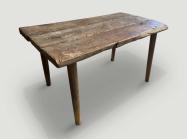
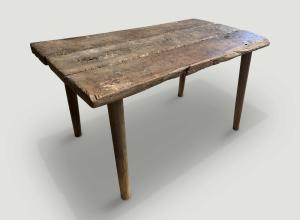
Andrianna Shamaris, Wabi-Sabi Console or Side Table.

In Andrianna Shamaris’ SoHo penthouse, reclaimed 17th-century floorboards, sun-bleached teak furnishings, carved Indonesian artifacts, and aged brick walls together convey a certain mood. “This loft is about imperfection,” the furniture designer says. “I didn’t want flat walls or sterile surfaces. I wanted soul.” The interior makes the new feel timeworn and the old newly alive—a heartwarming vibe that helps explain why wabi-sabi is back in the design conversation.

Designers point to a contemporary backdrop of CAD-straight architecture, digitally filtered portraiture, and AI-smoothed renderings. “We are faced with so much perfectionism in social media and film and TV culture, especially around human physicality, that we need a counterpoint,” says multi-hyphenate creator Martyn Thompson. “A history of human touch to calm the often-alienating nature of technology.” 

In practice, that often means being unfussy with purpose, prioritizing simplicity over excess and patina over shine: raw wood, linen that crinkles, plaster marked by the trowel. “In photography,” Thompson explains, “the wabi-sabi might be a wilting flower or an unmade bed.” For his recent exhibition, Hard and Soft, at Melbourne’s Oigåll Projects, Thompson extended a wabi-sabi aesthetic across textiles, pottery, glass, and even plinths. “We made plinths that I painted, sanded, and repainted for a sense of age,” he explains. “I wanted the show to look lived in, not rarefied.” As for the expressively glazed ceramics, he says, “I work with sponges and splashes to keep a sense of the accidental.”

Wabi-sabi originally appeared in objects through wabicha, an austere Japanese tea practice nurtured in the 15th century by Zen monk Murata Jukō and Sakai merchant and tea master Takeno Jōō and codified by Senno Rikyū. Wabicha stood apart from showy tea ceremonies with ornate Chinese imports, shifting high-status aesthetics from opulence to local craft.

Japanese art critic Soetsu Yanagi’s writings from the 1910s through the 50s argued for the dignity of the handmade, useful, and ordinary in the modern era. The Unknown Craftsman, a collection of his essays translated into English in 1972, influenced not only Japanese makers but also Western designers craving an escape from postwar industrial artifice. In the midcentury United States, those values arose through material honesty and a reverence for process. George Nakashima left live edges on hardwood chairs, tables, and benches and joined fissures with butterfly keys, turning irregularity into a revelation. His Pennsylvania workshop—now run by his daughter, Mira Nakashima—continues to let wood speak through its natural form.

Courtesy of the artist. Photo by Eryca Green.

Martyn Thompson, vessel in the solo exhibition Hard and Soft at Oigall Projects. For the show, Thompson applied the wabi-sabi aesthetic to works in a variety of media.

Isamu Noguchi merged traditional Japanese techniques with modernist silhouettes in his Akari light sculptures, made from washi paper over bamboo ribbing. Their handmade fragility gave impermanence a tangible form. A late-20th-century European translation of wabi-sabi came from Axel Vervoordt, who began crafting interiors of lime-plastered walls, natural color palettes, reclaimed materials, and overlooked antiques. A new look of worn minimalism became aspirational for many. In a different way, Ron Arad’s 1981 Rover chair—an upcycled Rover P6 car seat mounted on bent-steel tubes—turned a mass-produced object into high-end design. This widened the wabi-sabi idea to include recontextualized manufactured parts.

Today, many artists and designers use salvage and deadstock materials, embrace bubbles in glass art and freeform glazes on pottery, and let fabrics fray and fade. The point is to treat accidents and aging as collaborators, rather than enemies. 

Shamaris has pursued that approach for decades in her furniture collections crafted from weathered wood and repurposed antiques. “My motto has always been ‘perfection is imperfection,’” she says. “Newly made pieces, to me, feel soulless.” Thompson adds, “Imperfect surfaces draw in the eye. Visually, you move across and around them, whereas a flat or perfect surface stares straight back at you.”

In Japan, wabi-sabi has seeped into the wider culture. Naoki Sato’s design gallery Somewhere Tokyo represents several makers who display a certain wabi-sabi savvy, including straw artist ARKO and woodworker Hiroyuki Nishimura. ARKO composes her wall sculptures from rice straw left behind after the harvest, recalling the Buddhist emphasis on the transient nature of everything. “The fragile life of the rice plant is directly incorporated into her works,” Sato explains. “In them, one may see a sense of mujōkan, awareness of impermanence, and a beauty in things that are not eternal.”

Nishimura carves functional sculptures from fallen trees and discarded timber in the form of funky stools and teetering shelves, whose natural cracks can deepen over time. “The characteristic of his work lies in leaving things raw, keeping the nuance as it is, and bringing the piece to completion in that state,” Sato says.

However, Sato points out, “Nishimura’s works, when seen by Japanese people, may not really feel like wabi-sabi. If they appear that way to Western eyes, it may be because, unconsciously, his sensibility as a Japanese person is expressed in them.” He adds, “For us in Japan, the sense of wabi-sabi is ingrained, even if we are not aware of it.”

*This article originally appeared in Art & Object Magazine's Winter 2026 issue.
About the Author

Christopher Siwicki

Christopher Siwicki is an architectural historian, specializing in the ancient world. He is a postdoctural Research Fellow at the Norwegian Institute in Rome and an honorary research Fellow at the University of Exeter. He is the author of Architectural Restoration and Heritage in Imperial Rome (Oxford University Press).

Subscribe to our free art newsletter!

Webform
Art and Object Marketplace - A Curated Art Marketplace