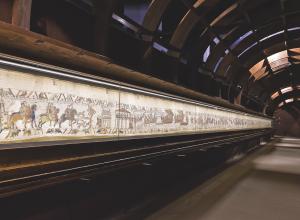

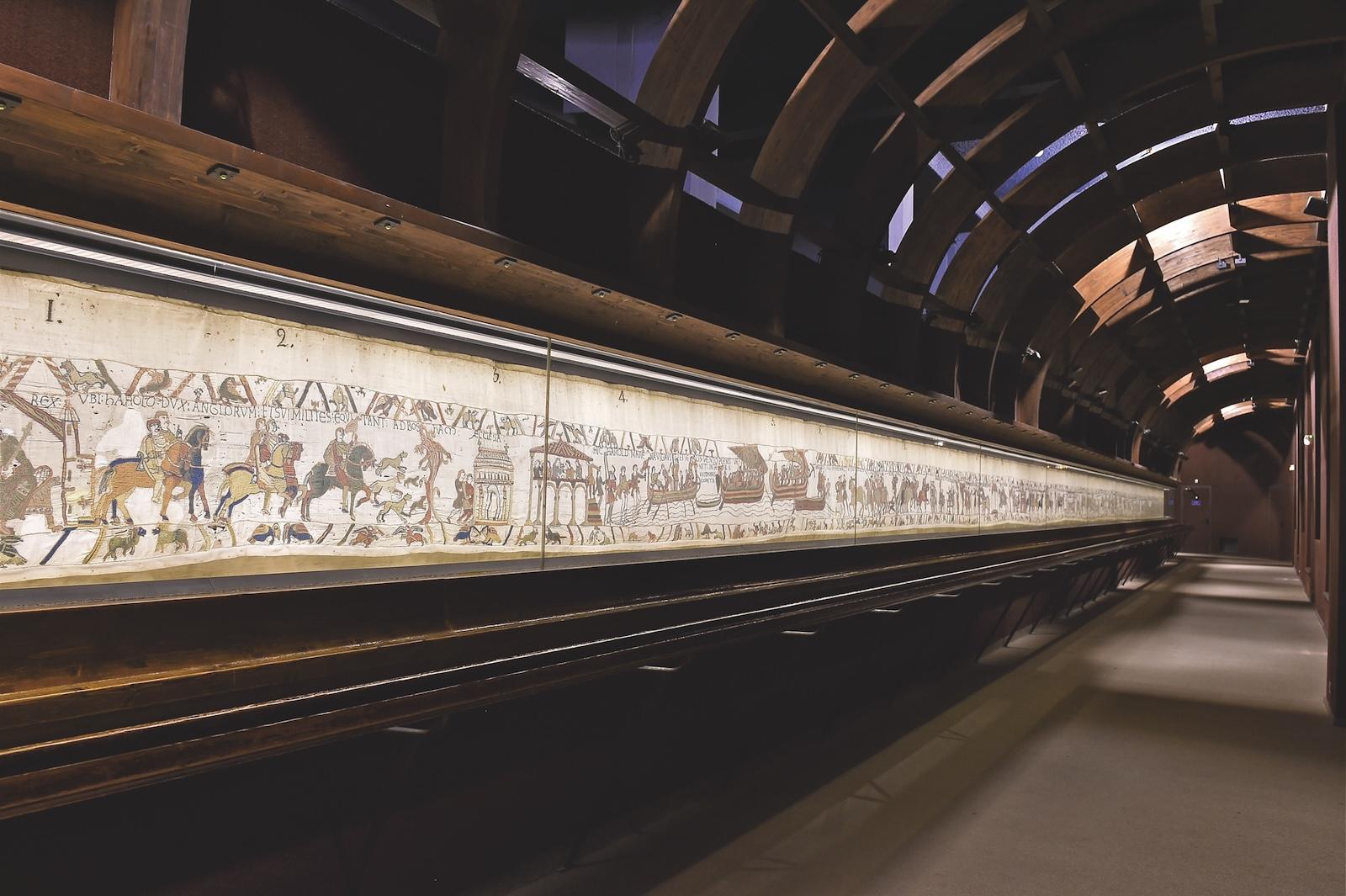
The Bayeux Tapestry not only narrates a major historical event but also records information about everyday life in medieval England and France.
This past July, U.K. Prime Minister Keir Starmer and French President Emmanuel Macron signed a historic agreement allowing the Bayeux Tapestry—a 230-foot-long strip of medieval cloth embroidered with images telling the story of the Norman Conquest—to travel to England for an exhibition at the British Museum that will open in the fall of 2026. In return, the museum will loan France some of its treasures, including the 7th-century Anglo-Saxon burial hoard found at Sutton Hoo in Suffolk and the so-called Lewis Chess Pieces, carved of walrus ivory in the 12th century. The Bayeux Museum in Normandy, where the Tapestry is currently housed, will be closed for renovation for two years, until late 2027.
The loan marks the first time in almost 1,000 years that the Bayeux Tapestry will be seen in the country where it was made. It was most likely commissioned in the late 11th century, not long after the events themselves, by Bishop Odo of Bayeux—William the Conqueror’s half-brother—with Anglo-Saxon artists doing most of the work. Although it generally embodies a pro-Norman point of view, the Anglo-Saxon defenders of the British Isles are depicted as brave soldiers.
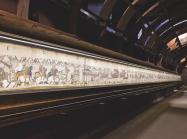
The scenes represented span the years 1064-1066, beginning with the succession crisis following the death of King Edward the Confessor and culminating with the Battle of Hastings on October 14, 1066, in which the English King Harold II was killed. The Bayeux Tapestry—technically not a tapestry, but a work of embroidery—constitutes a rare example of secular art in the Norman Romanesque style. The colors, in woolen thread on linen cloth, are vivid and fresh-looking, despite their age. The whole strip contains 58 scenes, 626 human characters, and 202 horses. Together with embroidered Latin texts, they not only give an account of the high-level political and military events but also provide an unparalleled level of detail about everyday life in medieval England and Normandy.
While the Tapestry returned to France not long after its manufacture, it went unmentioned in history until 1476 when an inventory of Bayeux Cathedral was made. Nothing further occurred until the 1720s, when the French Benedictine scholar Bernard de Montfaucon published drawings of portions of it. The first notice in English was written by the antiquary William Stukeley in his Palaeographia Britannica of 1746. After many vicissitudes (beginning with the French Revolution and including a near-kidnapping by the Nazi SS during World WarII), the Tapestry was returned to the town of Bayeux in 1945 and has been on view in the Bayeux Museum since 1983.
On the occasion of the announcement of the loans, George Osborne, Chair of the British Museum Trustees, shared, “Once in a generation, there’s a British Museum exhibition that eclipses all others. Think in previous ages of Tutankhamun and the Terracotta Warriors. The Bayeux Tapestry will be the blockbuster show of our generation. I know it will capture the imagination of an entire nation.” This time, the crossing of the English Channel will be an invasion, not by lethal force, but by the time-defying force of art.
*This article originally appeared in Art & Object Magazine's Winter 2026 issue.