


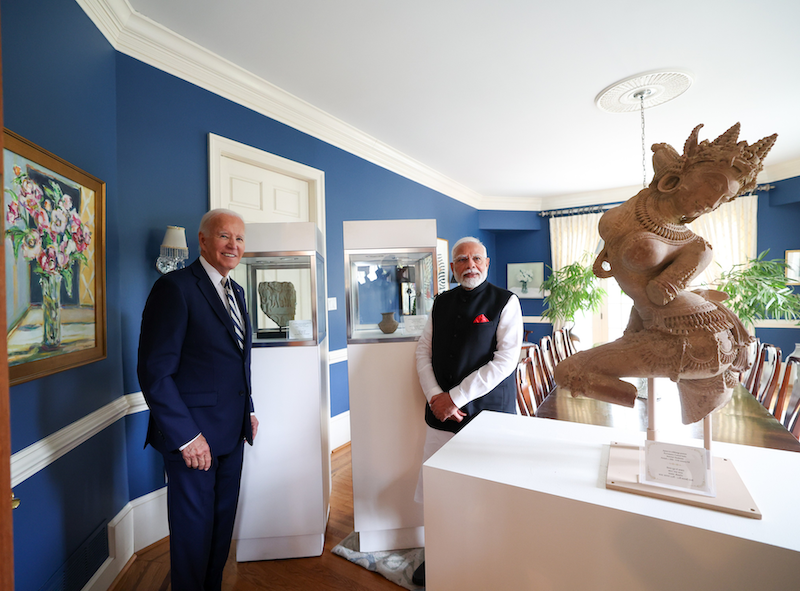

Of course, when the issue is current-day trafficking in stolen artworks, there is no room for ambiguity or objection. Investigations of rogue dealers like Kapoor or the infamous Robert Hecht (he of the looted Euphronios Krater returned by the Met to Italy in 2008) leave institutions little choice in the matter of repatriations, once it becomes clear that works in their collections were stolen recently. However, when it comes to the centuries-long colonial era, during which Western nations used their economic and military might to seize ownership of cultural properties, there has long been significant debate. Some in the art trade and in the museum world have asserted—and to some extent still do—that history is messy, cultures and populations shift, and therefore possession is nine-tenths of the law, if not ten-tenths. To that, replies are often in the spirit of Modi’s remarks on the occasion of the return of the 297 objects this past fall: that the objects “were not just part of India’s historical material culture but formed the inner core of its civilization and consciousness.” Certainly that is true of the Edo people of Nigeria, who are still ruled by an Oba whose dynasty stretches back to the medieval period and who have founded the Benin City National Museum to house their cultural treasures.
In other cases, such as, for example, modern Greece and Egypt, opponents of restitution often draw attention to the significant cultural and religious differences between the ancients and the moderns—greater, perhaps, than in India or Benin. But even then, who is to say that ancient works of art have not played a role in shaping “the inner core of civilization and consciousness” in those countries? Those are deep words, naming even deeper realities, and it would be bad form at the very least for an outsider to presume to judge the emotional importance of a work of art to those who include it in their lineage. Another argument sometimes heard is that these are now world cultural properties, of deep importance to all people, and therefore ought to stay right where they are, especially if that is a first-world location. But with the ubiquity of high-resolution internet images and comprehensive databases—Nigeria has created one called Digital Benin, by which anyone anywhere can access their treasures—not to mention the ability of works to be loaned for exhibitions around the world, such pleadings fall flat.
As with any cultural narrative, there are ironies aplenty. When modern Latin American nations ask for indigenous artworks to be restituted, it is irresistible to point out that these very same nations have an abysmal record of physically and culturally erasing their native populations. And yet, at the same time they really do consider Indian art to be formative for their “civilization and consciousness.” And then there is the question of exactly who was robbed of cultural property. As this column went to press, the U.S. Supreme Court declined to hear a petition by an advocacy entity called the Restitution Study Group, which tried to block the return of the 29 Benin bronzes by the Smithsonian on the grounds that the objects are the cultural heritage of enslaved African Americans and their descendants, and moreover that the Edo regime in 19th-century Benin was partly responsible for their enslavement.
Regardless of the back and forth, though, it seems that after long resistance and many delays, a corner has truly been turned when it comes to the restitution of cultural objects, that the art world is coming close to a general agreement that it will not tolerate stolen property in its midst.