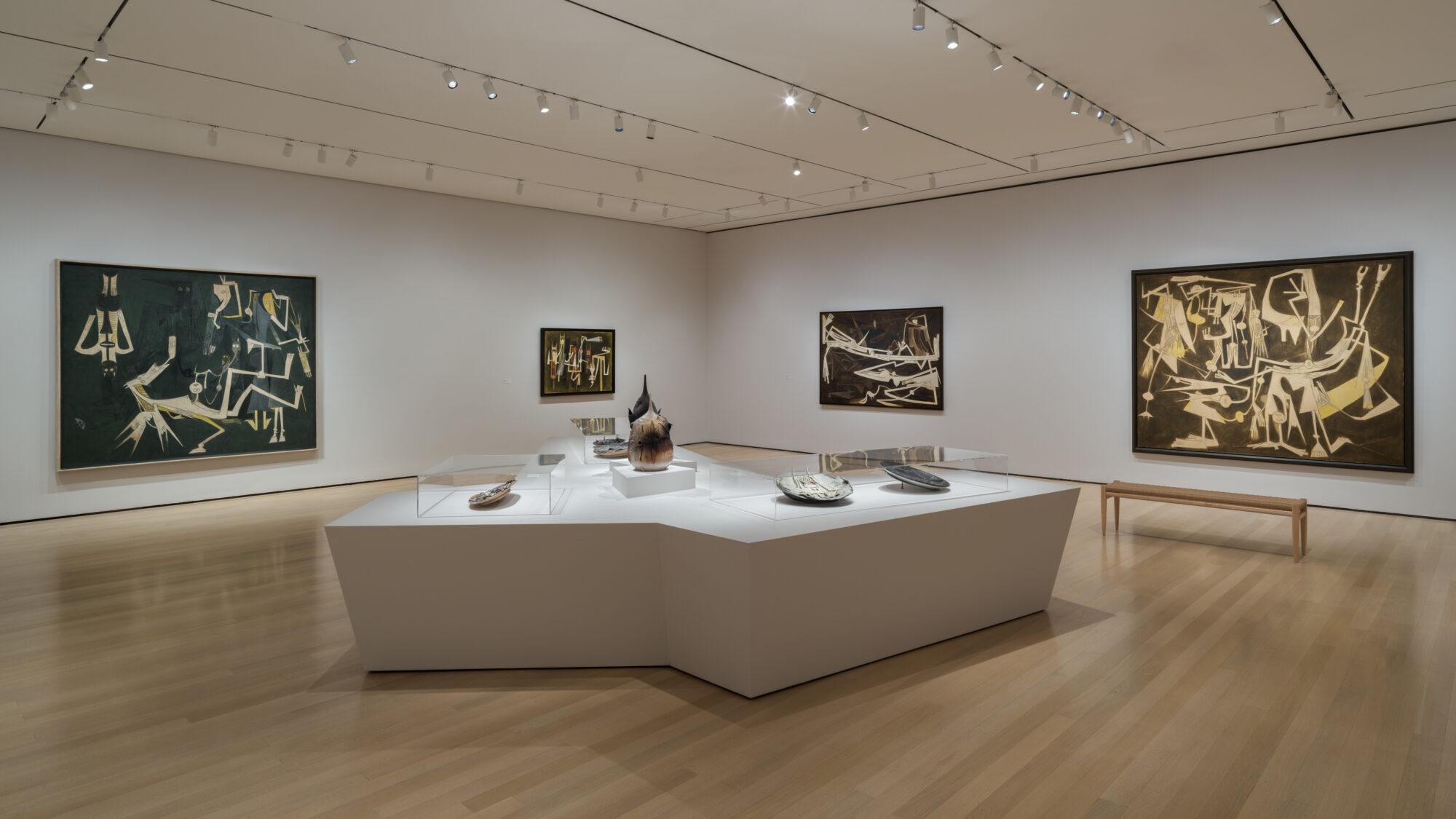
Wifredo Lam’s paintings expanded the horizons of modernism by creating a meaningful space for the beauty and depth of Black diasporic culture. Born in Cuba at the start of the 20th century, Lam forged his political convictions and commitment to modern painting in war-torn Europe in the 1930s. His exile and return to the Caribbean after 18 years abroad drove him to radically reimagine his artistic project through Afro-Caribbean histories.
For Lam, who was of African and Chinese descent, crafting his vivid new imaginary was more than a means of self-reflection. He famously declared that his art was an “act of decolonization.” His formal experiments, his transforming figures and landscapes, and his affinity for poetry and collaboration allowed him to disrupt and overcome the colonial structures he encountered in art and in life. “I knew I was running the risk of not being understood either by the man in the street or by the others,” Lam said, “but a true picture has the power to set the imagination to work, even if it takes time.” Wifredo Lam: When I Don’t Sleep, I Dream is the first retrospective in the United States to feature the full trajectory of Lam’s remarkable vision, inviting us to see the world anew.