
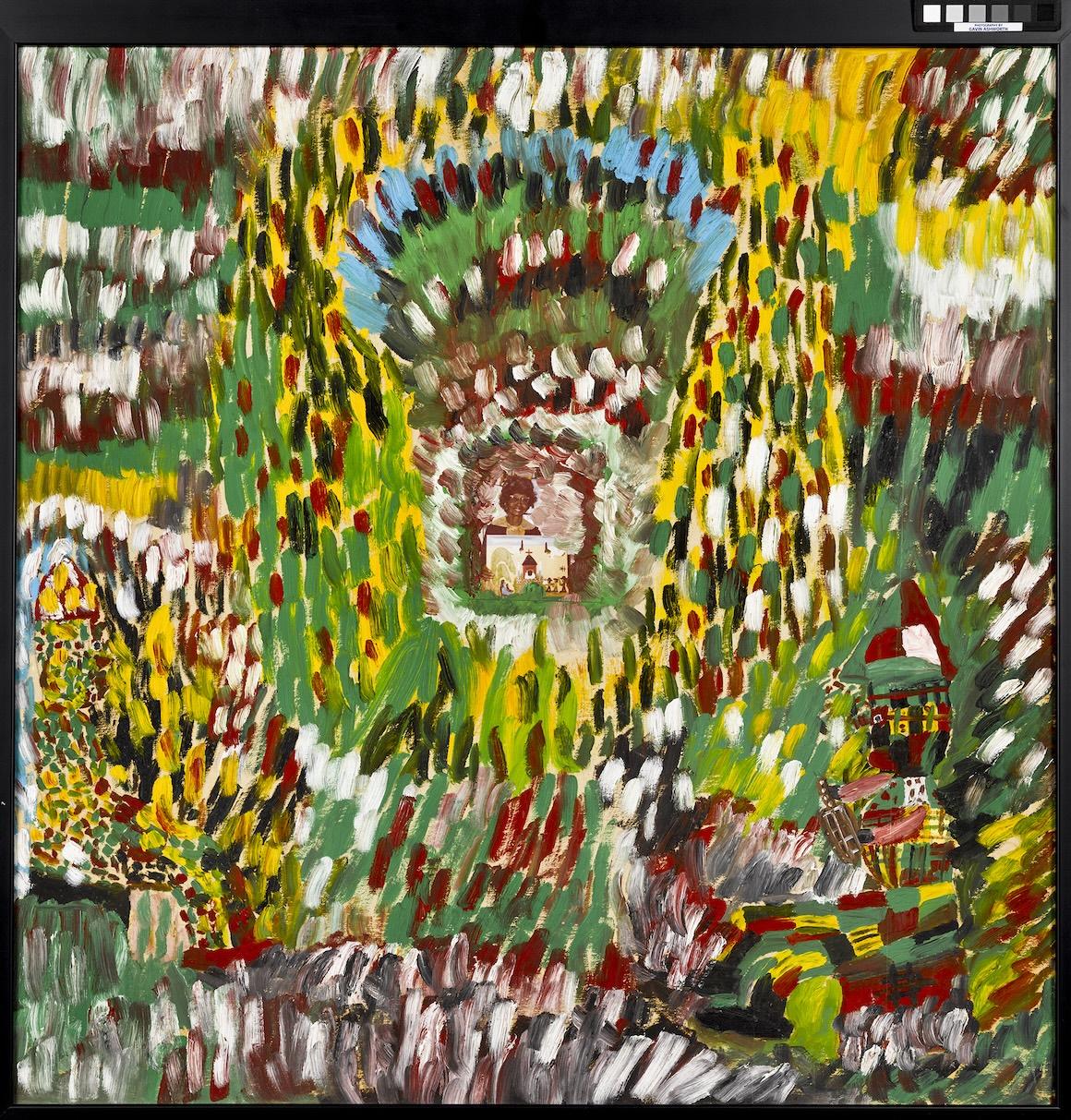
The bulk of the artist Clementine Hunter’s (1887–1988, Natchitoches Parish, Louisiana) works depicts scenes from the Melrose Plantation in Louisiana, where, starting when she was a teenager, Hunter had labored picking cotton, cleaning, and cooking. As Hunter recalled, “I paint the history of my people. My paintings tell how we worked, played, and prayed.” But later in her life, Hunter abandoned this style, stating such images “hurt me too much. I get dizzy.” Self-Made exhibits a 1975 self-portrait from the new aesthetic she adopted. Completed when she was in her 80s, she centered a photograph of herself holding one of her earlier paintings. Exuberant, expressive dashes of paint radiate outward, crowning her picture in blue within a personal, vibrantly blooming landscape. Here, she is an artist in a world of her own making.
For British artist Madge Gill (1882–1961, London, England), spirit guides offered a way to explore the self. Gill leaned deeply into Spiritualism after the traumatic losses of her son in the influenza pandemic of 1918 and the birth of a stillborn daughter in 1920. The artist stated in 1937 that “I felt I was definitely guided by an unseen force, though I could not say what its actual nature was.” Yet, the female figure she repeatedly depicted looked remarkably similar to the artist herself, hosting an oval face, circular eyes, pointed chin, delicate nose, and small lips. She named her spirit Myrninerest—sometimes interpreted as “my inner rest” or “my innerest”—who she said led her hand while creating.
Artistic practices of autobiography offered a way to challenge official historical records. Horace Pippin (1888–1946, West Chester, Pennsylvania) served in the all-Black 369th Infantry Unit, nicknamed the “Harlem Hellfighters”, and began painting scenes from his experience serving in World War I on his return. The war left permanent traces on his art-making: in 1918, a sniper’s bullet pierced his right shoulder, and his right arm had to be supported by his left hand whenever he worked at his easel. In Outpost Raid: Champagne Sector, Pippin paints a member of his infantry—possibly himself—confronting a snarling, disarmed Nazi soldier within a trench. Similar scenes were recorded in his wartime journal. At the time, images of The Great War often excised the contributions of Black soldiers, but in Pippin’s work, their victories and struggles are centered. He would later declare, “I don’t go around here making up a whole lot of stuff. I paint exactly the way it is and exactly the way I see it.”
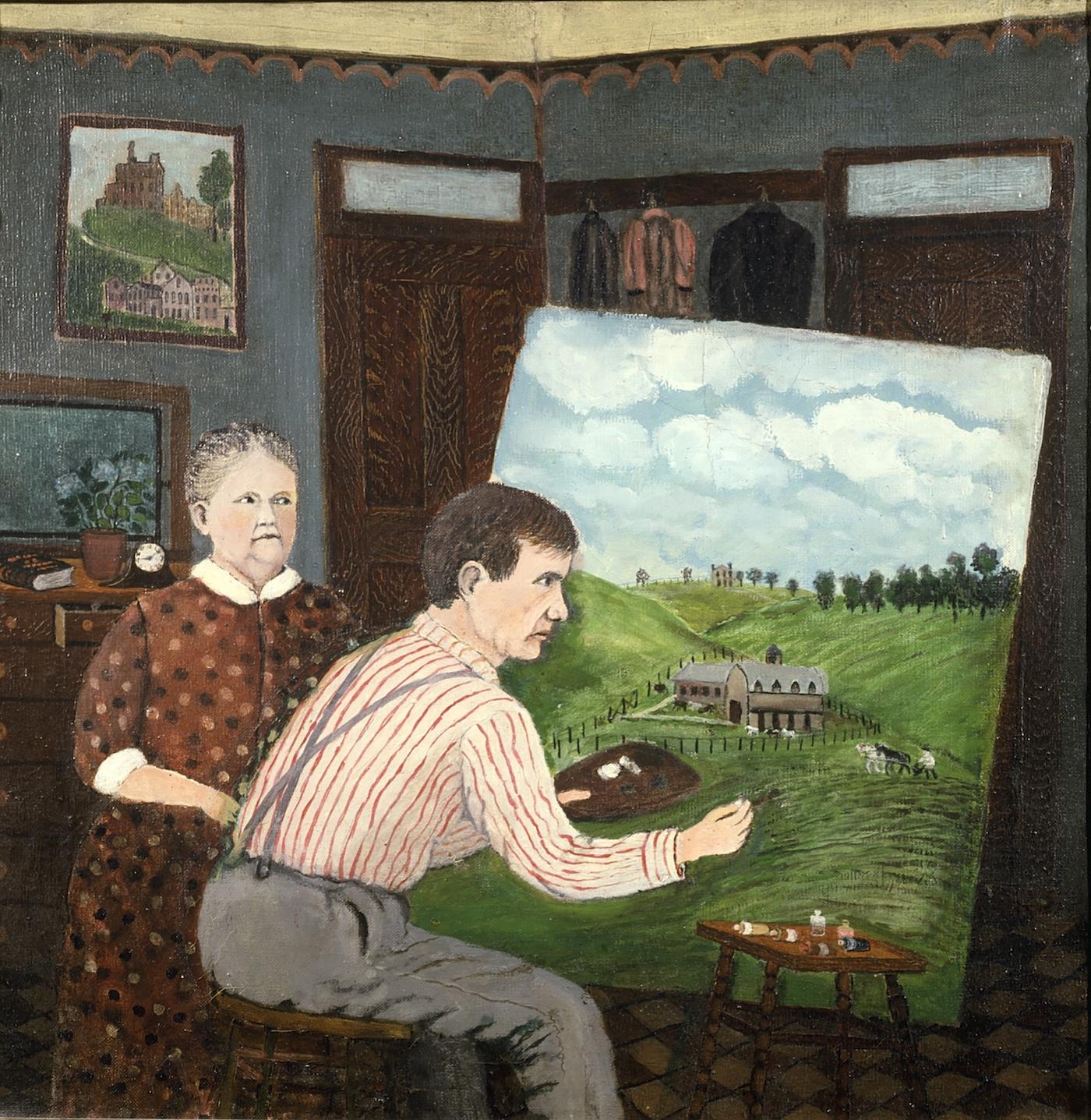
As the United States celebrates its semi-quincentennial, Self-Made is a reminder that individuals can chart paths of their own making. Agency can be the seed of revolution. The artists gathered here draw on their personal experiences to forge the stories we inhabit and inherit.
*This article originally appeared in Art & Object Magazine's March/April 2026 issue.