Gallery  December 1, 2025  Marcus Civin

Wifredo Lam’s Spirits and Figurations at the MoMA

Photograph by Jonathan Dorado. Courtesy The Museum of Modern Art.

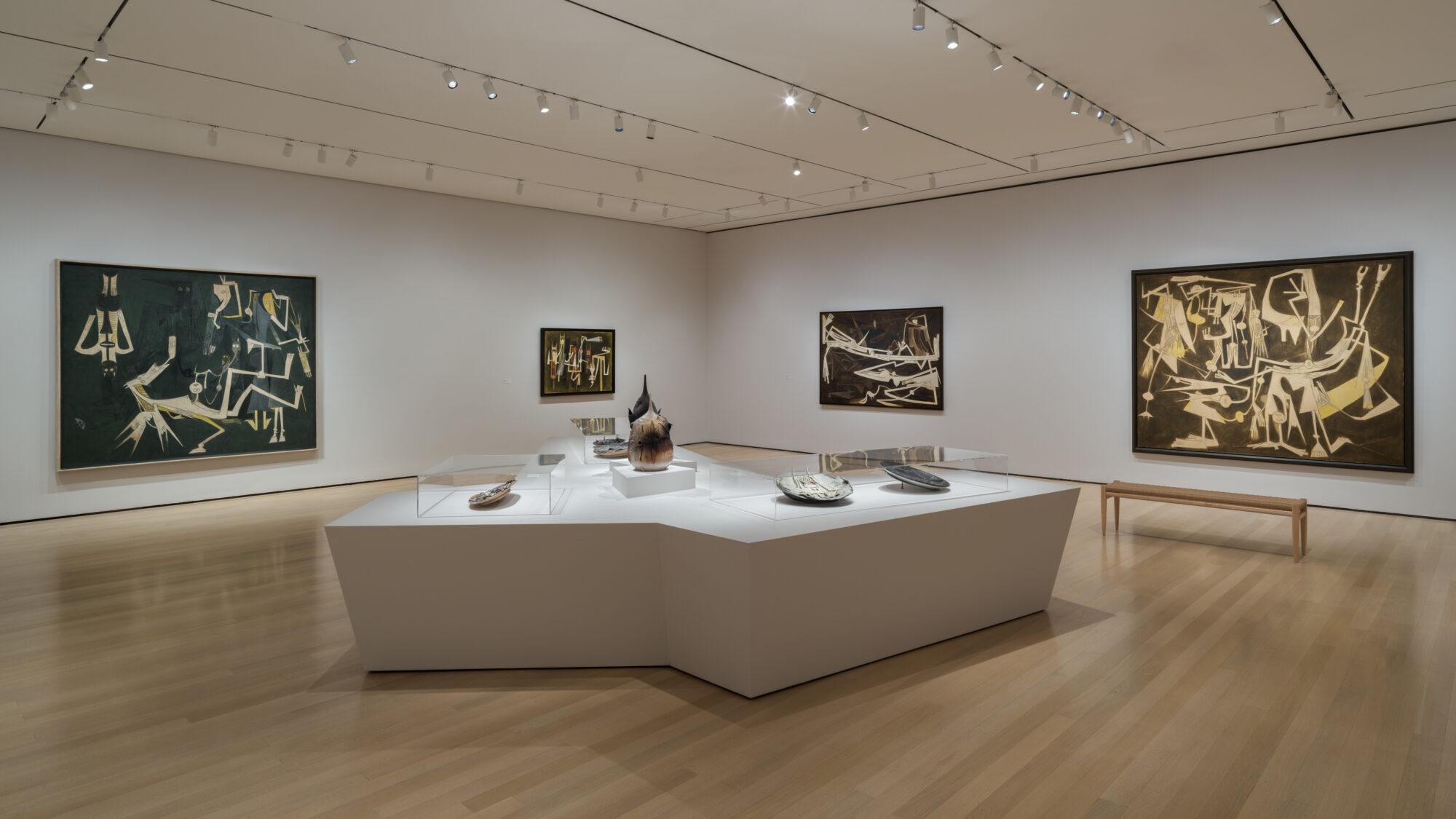
Installation view of Wifredo Lam: When I Don’t Sleep, I Dream on view at The Museum of Modern Art.

When I Don’t Sleep, I Dream, the major retrospective now on view at the Museum of Modern Art in New York, positions Wifredo Lam as a political, spiritual, and insurgent force—a world-builder who ultimately slips classification.

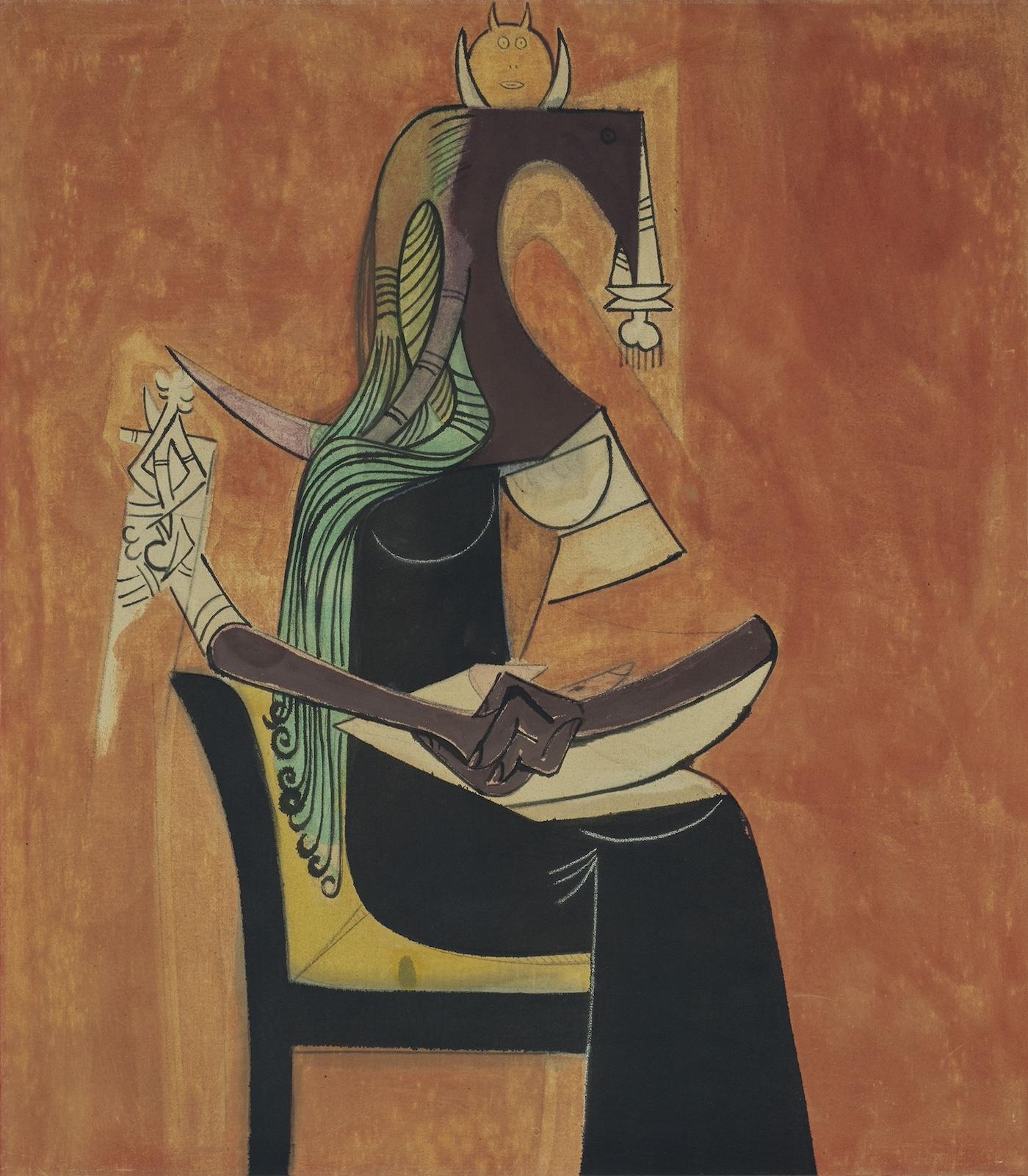
In the 1984 poem, When I Look at Wifredo Lam’s Paintings, written two years after the artist’s death by Jayne Cortez– a prominent figure in the Black Arts Movement– Cortez identifies powerful spirits from African religious traditions in Lam’s work. These include Oyá, a goddess of death, storm, and change who can turn herself into a bull, and Yemaya, worshipped as the mother of all humanity and associated with water and the moon. Likewise, students of African art will recognize in Lam’s paintings, sculpturesprints, and drawings references to circular, horned Baule kple kple masks and the multi-tiered compositions, maternity figures, and divination vessels in Yoruba wood carvings. 

Private collection © Succession Wifredo Lam, ADAGP, Paris / ARS, New York 2025.

Wifredo Lam, Je Suis (I Am), 1949, Oil on canvas, 49 × 42 15/16″ (124.5 x 109 cm).

Born in Cuba in 1902, Lam grew up amidst African, Afro-Cuban, Catholic, and Chinese religious practices. His mom, Ana Serafina Castilla, had a Spanish dad and an African mom. Lam’s dad, Enrique Lam-Yam, a Chinese immigrant, scribe, and calligrapher, hung Confucian writings in their home. Scholars have recently pointed out similarities between Lam’s seminal work from the mid-1940s and Chinese ink wash paintings with expressive brushstrokes. Similarly, as is well-known, Lam’s style and subject matter were also shaped by tumultuous histories: he built bombs, designed posters, and picked up a rifle for the anti-fascists during the Spanish Civil War; he befriended the Cubists, joined the Surrealists, and embraced the anti-colonial Négritude movement.

In the first gallery of When I Don’t Sleep, I Dream, the early self-portrait, Sol (Sun), 1925, shows the young artist seated, posing casually and confidently before a tropical sunset, holding a fan and wearing lipstick, cat-eye makeup, a floral pastel pantsuit, a dangling necklace, and slippers. The painting reads as a declaration of harmony with the natural world and a refusal of fixed identity. 

Nearby, Untitled (The Couple), 1937, dispels the notion– popular at least until the 1980s– that Lam was merely a Picasso protégé or imitator. At first glance, the gouache might appear to echo Les Demoiselles d’Avignon (The Young Ladies of Avignon), the fetishized, pig-ignorant, racist, and sexist brothel scene of 30 years earlier. However, Lam’s take shows a nude Black man who seems to dance shyly with a lighter-skinned woman as she undresses, both with downcast eyes, perhaps conscious of the stakes of their interaction, weighted by difference rather than only titillated by it. Although Lam was influenced as an artist by Picasso, he improved the enterprise.
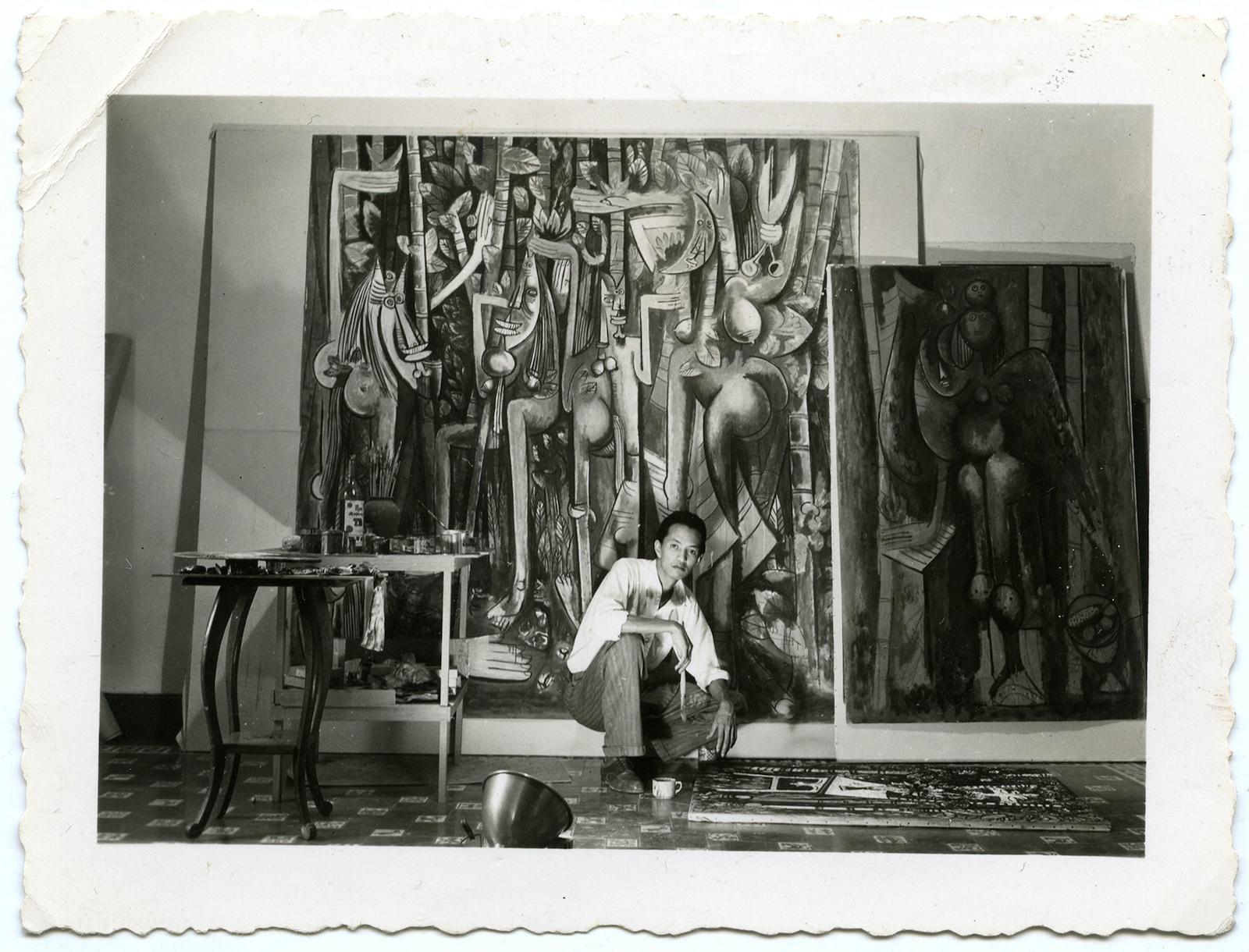
Courtesy The Museum of Modern Art.

Wifredo Lam with La jungla (The Jungle), 1942–43, La mañana verde (The Green Morning), 1943, and La silla (The Chair), 1943, on the floor, in his Havana studio, 1943 Archives Wifredo Lam, Paris

​Most of the retrospective presents Lam’s mature style, often rendered with urgency and on paper, and his animist lexicon of violent births, sharp-toothed creatures, and crescent moons presiding over murderous nights. A weakness of the exhibition is the museum’s self-congratulatory tone in celebrating Lam. They could be more forthright and apologetic about the institution’s previous contributions to his underestimation through exhibition and publishing as chronicled in John Yau’s 1988 essay, Please Wait By The Coatroom: Wifredo Lam in the Museum of Modern Art, originally published in Arts Magazine

Further, the staid curation, after the first room presenting Lam’s early development, focuses on a chronological string of sometimes subtly different treasures displayed similarly, sadly putting a damper on a vital artist through uninventive exhibition design. Lam’s more abstract untitled compositions from 1958, which suggest maps or cage-like architectures, and his ceramics are welcome deviations here. 

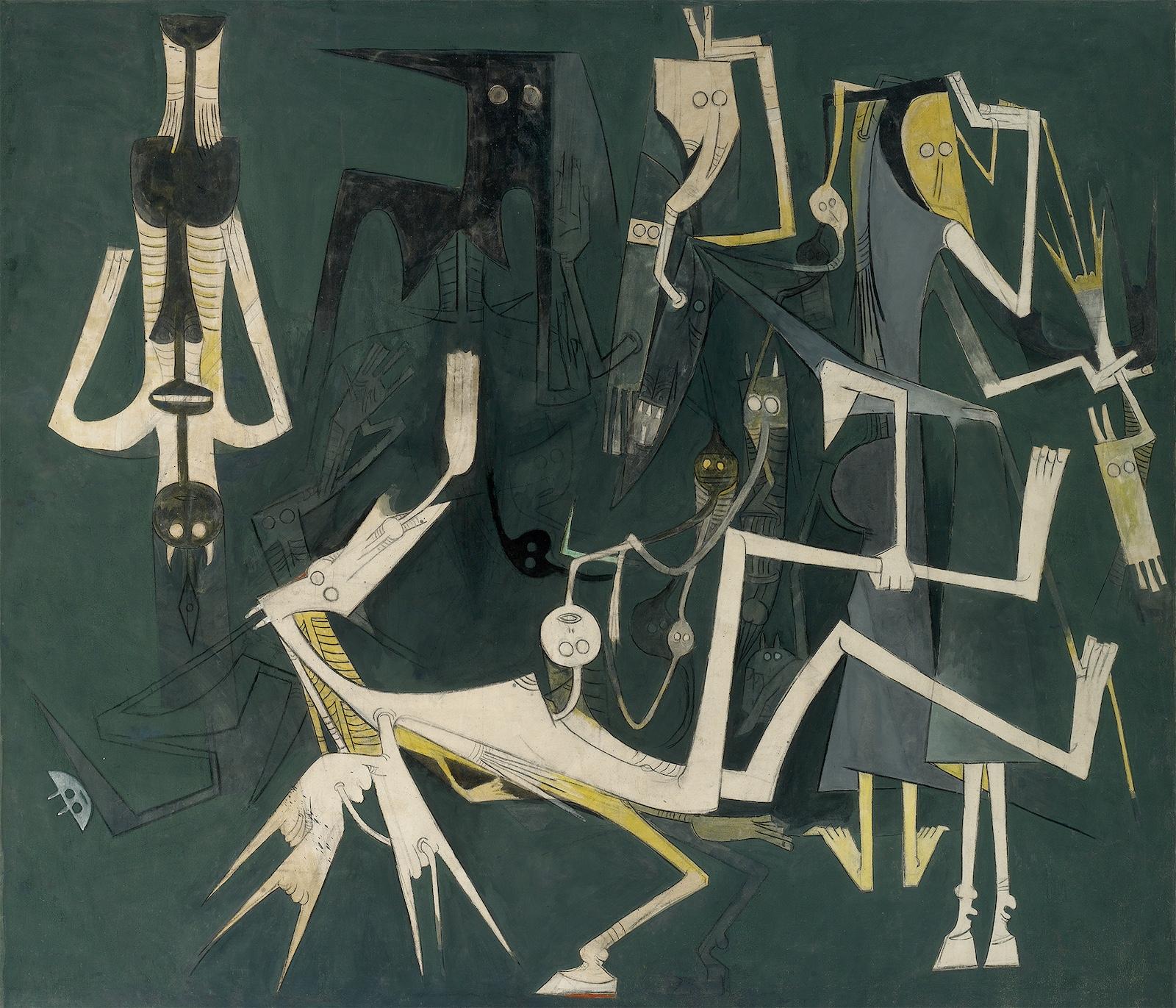
Private collection. Courtesy McClain Gallery © Succession Wifredo Lam, ADAGP, Paris / ARS, New York 2025.

Wifredo Lam, Les Abalochas Dansent pour Dhambala, Dieu de L’unité (The Abalochas Dance for Dhambala, the God of Unity), 1970, Oil on canvas, 6’11 ⅞” × 8′ (213 × 244 cm).

Over time, the figures in Lam’s crowded scenes grow more angular and alienated. In one of the final galleries, Les Abalochas Dansent pour Dhambala, Dieu de L’unité (The Abalochas Dance for Dhambala, the God of Unity), 1970, thin figures wear what seem to be hoods and gas masks. Suspiciously eyeing one another, they form a haphazard tribute to the togetherness invoked in the title of the piece. Compare that with Satan, 1942, which depicts two part-human horses intertwined in a tender embrace, gazing towards the viewer as if on watch, testicles hanging from one of their chins. 

When I looked at Satan in the MoMA galleries, I thought of the Swiss-German artist Paul Klee’s monoprint Angelus Novus (New Angel), 1920, which the German philosopher Walter Benjamin described as an “angel of history,” its face turned back to see past disasters, longing to repair them, while an unthinking drive for progress propels its body forward. The “devil of history,” then, is multiple rather than singular, a pair maybe bewitched by each other or by divine force, but still on edge, knowing they are vulnerable. This two-headed couple actuates histories best understood, much like Lam’s oeuvre, as interwoven narratives of cultures, ideas, and environments— crossed paths bedeviled because they are exposed and at the mercy of any passing fool or monster.

40.761548513689, -73.97737095

Wifredo Lam: When I Don’t Sleep, I Dream
Start Date:
November 10, 2025
End Date:
April 11, 2026
Venue:
MoMA
About the Author

Marcus Civin

Marcus Civin is a writer who lives in Brooklyn. He has written recently for ArtReview, BOMB, Dear Dave, Afterimage, and Sculpture, among other publications.

Subscribe to our free e-letter!

Webform
Art and Object Marketplace - A Curated Art Marketplace